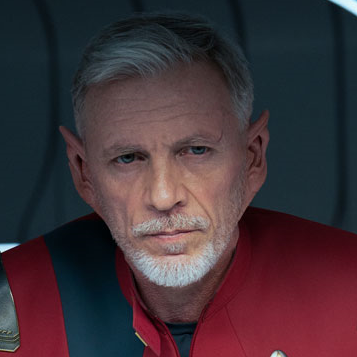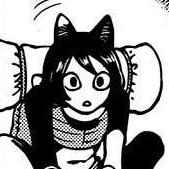

I want to live!
- EvilKirk’s last words
Whatever else you want to say about EvilKirk, it’s pretty clear that he didn’t want to be merged back into the single Kirk. Despite this, there is no shortage of reasons why it was a good idea to merge the Kirks: the Enterprise needed its CO back, GoodKirk wanted to do it, and it seems possible that the strain of remaining split would have eventually killed EvilKirk anyways. However, the fact remains that EvilKirk did not consent to the procedure which ended his existence.
Clearly the circumstances here are quite different and there’s basically no argument to be made that allowing EvilKirk to continue to exist would benefit any involved party, EvilKirk included. But for the purposes of this comparison, the only fact that really matters is that EvilKirk was just as passionate about his desire to continue existing as Tuvix was.
Yet—and it’s obvious where I’m going with this—“Spock murdered EvilKirk” is not a meme.
So what gives? Did Spock murder EvilKirk or not? If yes, why does he get a pass while Janeway is condemned?
Yet—and it’s obvious where I’m going with this—“Spock murdered EvilKirk” is not a meme. …[W]hy does he get a pass while Janeway is condemned?
I’m gonna cheat here a little bit. There are lots of things about the Tuvix debate that really are not about Tuvix; we’ve seen Tuvix elicit underlying opinions about everything from abortion to the trolley problem, and we’ve often seen thinly-veiled misogyny lurking beneath the surface as certain folks appear interested in finding any flaws in Captain Janeway they can.
So, yes, somewhat trivially, I think that Spock does not get condemned in part because he enjoys the luxury of not being targeted by misogynists. I think it’s a small part, but surely a part.
I think the reason there aren’t memes is because, well… “The Enemy Within” is an old episode, it never attracted attention through debate, and also it’s a gross episode where EvilKirk straight up attempts to rape Yeoman Rand, and then Spock makes a joke (! Spock! A joke!) about it at the end of the episode. I’m sure it’s an episode numerous folks have tried to forget. (I know I have.)
So, in terms of using the episode as a barometer to evaluate our own reactions to the two situations, I think there are overriding contextual factors that drown out any insight we might gain.
As an aside, I also think there is a pretty straightforward argument that EvilKirk (and GoodKirk, for that matter) was not mentally competent. He was, by definition, the remnants of an individual who had had a significant piece of their person torn away from them traumatically.
I think there’s actually an odd but useful comparison to dementia here: dementia does cause some individuals to behave “out-of-character”, immorally, or just meanly. If there were a “transporter reintegration” equivalent to treating dementia, and the patient said, “No, I want to stay like I am”… then I think probably the patient’s wishes would be ignored.
Part of the reason “Tuvix” is hard is because, at least superficially, Tuvix appears mentally competent, so it’s much harder to justify ignoring his wishes.
(As a second aside, one thing that always surprises me about the Tuvix Discourse™ is how little attention is paid to Tuvix being… well, somewhere between an asshole and a creep. He is incredibly manipulative toward Kes, preying on both her feelings for Neelix as well as her mentoring relationship with Tuvok. Neelix of course always was a bit possessive and jealous, but he at least was written “with a good heart”; I felt like Tuvix took those same qualities, but added a Tuvok-esque cold calculation to it. In any case, to me there’s a mildly interesting parallel between these two episodes where there’s this tone-deafness to the way the writers treat the behavior of the “transporter accident individual.”)
why does he get a pass while Janeway is condemned?
Firstly, the episodes are doing completely different things, and have completely different presentations. “The Enemy Within” uses the transporter malfunction to examin the duality of man, and doesn’t address the ethics of the situation in any way. That’s going to inform the viewers’ reactions, just as bringing Janeway’s decisions regarding Tuvix to the forefront of that episode informs the viewers’ reactions of that.
Secondly, Tuvix himself would have agreed with Spock - at least, at first. He was initially an active participant in trying to find a way to undo the situation. Over time, though, he changed…and so did Janeway and the Voyager crew. Tuvix is given a name. He’s given a job. Janeway calls him an officer and an advisor.
In short, Janeway granted Tuvix personhood…and then unilaterally stripped it away.
To point one, yep, fair. I’ve unceremoniously dropped “The Enemy Within” into a context it was never intended to be examined from.
To point two, I agree that Janeway was both the source and the termination of Tuvix’ personhood, but I don’t see the relevancy. What bearing does Tuvix’s personhood have on how we describe Janeway’s actions, or the discussion about whether those actions were justified?
Well, if he’s a person, he has rights…
Ah. Tuvix was a person, EvilKirk was not?
I’m admittedly dancing around EvilKirk a bit, because the episode engages with the two Kirks in such a way that they’re treated as a problem to be fixed, rather than a moral dilemma.
The Tom Riker situation is perhaps more fitting in terms of the way the episode itself handles the situation. Of course, that episode also is fairly uncompromising about Will and Tom each being individuals with the right to live…
I think that’s an oversimplification of what GP was getting at.
Tuvix was an accident, knew and accepted that fact, and initially was voluntarily assisting in finding a way to undo it. He seems more than capable of grasping, even at that early point in his existence, that undoing the accident means the end of him.
GP made the argument that his demeanor started changing as he got a name, a job, responsibilities etc. All the superficial hallmarks of a “person” in the very limited environment of the ship.
Nobody is saying he wasn’t a person from the start, but getting assigned all the trappings of what he saw to be individual persons undoubtedly started him thinking of himself as a person as well instead of just an accident to be corrected.
I’m going to add to that, as this post made me rewatch it as we speak 🙂
The two very first lines Tuvix speaks, when challenge 6 for his identity, are “I am luitenant Tuvok. And I am Neelix.”
He really didn’t realize he was a person yet - he thought he was two persons.
Had you asked, in that initial time, whether he would like to be split up, I’m sure he would have answered in the positive.
Of course he’s allowed to change his mind as realization grows, so the whole thing remains a dicey proposition, but imo it just reinforces the fact that it was Janeway who triggered his (becoming aware of his own) personhood.
Isn’t the main difference that neither could survive if they remained separated? They would both eventually die unless they were reintegrated.
Whereas in Tuvix’s case, the merged being was in no danger of death and could have lived a long healthy life.
That is true and to @ValueSubtracted’s point, speaks to the fundamental difference between the morality tale that each episode is setting up for our consideration. “The Enemy Within” aims to make the viewer uncomfortable by suggesting that Kirk’s decisiveness is derived from his “evil” half and isn’t offering any commentary on the personhood of the “evil” half. So much so that they short circuit that possibility by slapping an expiration date on EvilKirk.
Best I can give you is that it’s still technically murder if you kill a condemned man.
Killing two people who are both destined to die in the very near future to save one who will live for a considerably longer period and save a greater number of lives would be the right thing to do from a utilitarian standpoint. Tuvix, meanwhile, is a healthy being who was competent to discharge his duties and posed no threat.
Consequently, while there is an argument to be made that killing one person to revive two others is a net benefit, the burden of suffering on that one person is extreme, and whether or not it is outweighed by the positive nature of the two others returning to live is very much a matter of individual outlook.
It is also worth noting that Tuvok and Neelix as they existed before could be considered “already dead” as a result of their combination into a single entity. Thus you could argue that what actually happened is that Tuvix “died” so that clones of the deceased Tuvok and Neelix could be created from him. Admittedly this is a shaky argument given the whole “do transporters actually kill people in-universe” thing.
Janeway made the right choice with Tuvix. It might have been murder but the alternative was double murder