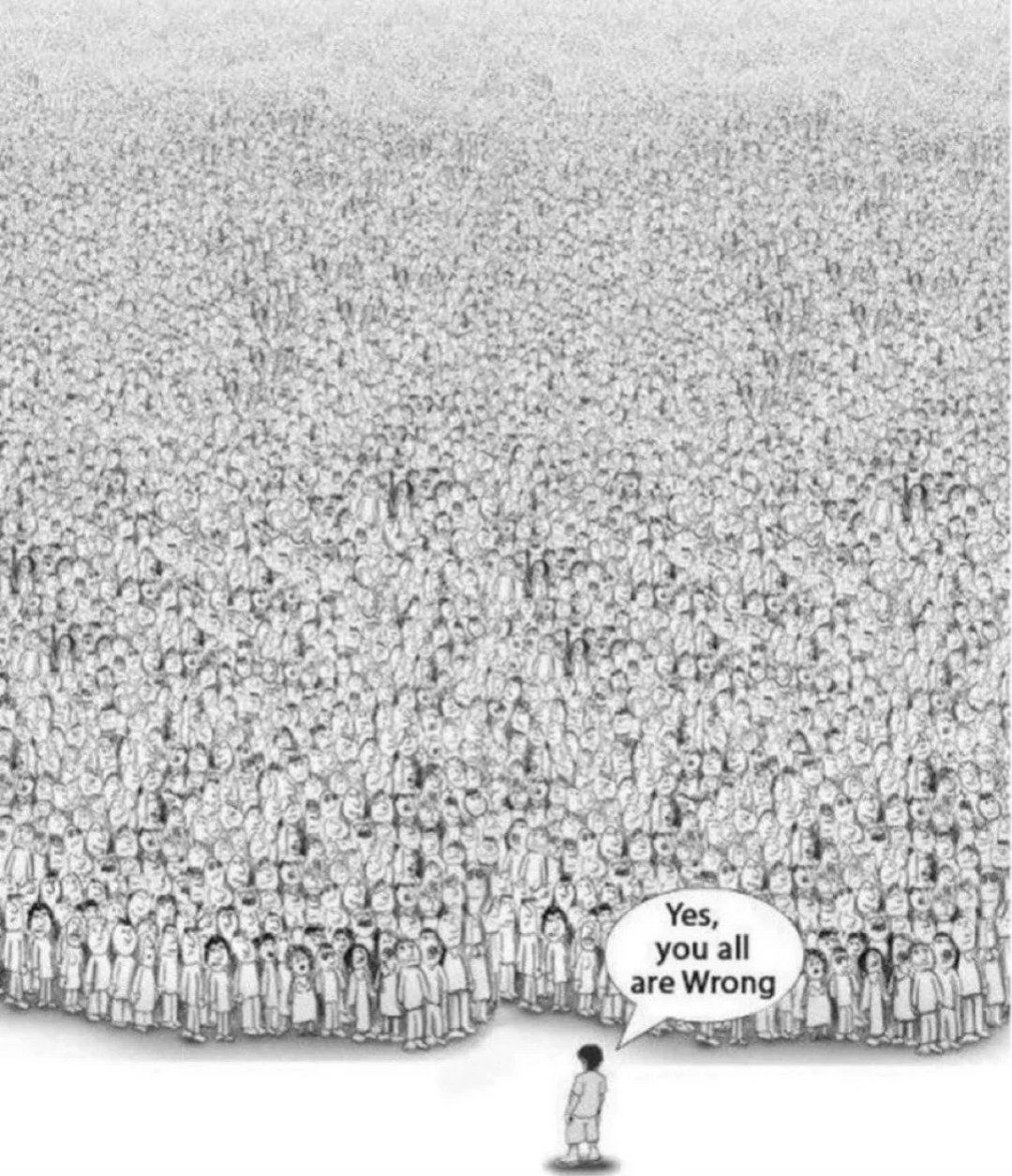
That this meme is low effort content and it’s spamming everywhere
It’s the first time I’ve seen it.
Can I borrow the rock you’ve been under?
I guess I just unsubscribe from communities where there are a lot of low-effort memes?
But seeing it here is fine, it’s started some discussion.
The real reason I posted it. There’s a decline in user engagement and posts after the peak some months ago (reddit API) .
As it always does. shrug
Memes are low effort in general
health insurance != healthcare
health insurance profits only exist at the expense of human suffering.
but lets make sure everyone has insurance but not care
I thought this thread was for hot takes 😉
Is this your first time in an “unpopular opinion” thread? lol
health insurance isn’t really insurance either.
it’s like a health services subscription plan with a million convoluted rules.
I wish more people understood this. Insurance is an extra cost paid to protect from catastrophe. Anything that saves you money on a regular basis is not insurance: where does the extra money come from?
Pet insurance is another bizarre misunderstanding of this nature. Unless there are procedures you are unwilling to forego to save your pet, but completely unable to afford, you are throwing money away in the long run. The entire actuarial profession exists to ensure this fact. Take what you’d spend on premiums, and invest it in a good savings vehicle instead.
insurance is part of health plans. There is a deductible and an out-of-pocket max, which are both designed to protect you from those catastrophic risks. But because those catastrophic risks are best addressed by preventative care, and regular checkups, and freakin’ gym memberships, so the economics of insuring health becomes the economics of health incentivization, fucking around to figure out what it takes to get people to take care of themselves in advance rather than waiting but not getting people to go to doctors for frivolous issues.
Myers Briggs is posh astrology.
It shouldn’t be taken as scientific truth but it can help you know yourself and others better, and it’s an insult to compare it to astrology because at least it’s not based on completely random things like the position of the planets when you were born. The issue is that most people only know MBTI as online tests, which are self-report and have extremely vague and stereotypical questions that can very easily be manipulated to get whatever result you want, with the worst offender being the most popular one, 16personalities, which isn’t even an actual MBTI test but a BIg 5 one (which is not to say Big 5 is bad, but it’s very misleading to map it to MBTI types). In reality to use MBTI somewhat effectively is going to take studying Carl Jung’s work, how MBTI builds on that, lots of introspection, asking people about yourself, and lots of doubting and double checking your thinking. And very importantly you have to accept that in the end this all isn’t real and just a way to conceptualize different aspects of our personalities and it’s in no way predictive, you have to let go of stereotypes, anyone can act in any way, it’s just about tendencies.
deleted by creator
Young people are people and deserving of rights, including but not limited to the vote. There is no stupid thing a young person could do with their vote that old people don’t already do and we don’t require them not to in order to keep their vote.
I agree. I wish the voting age was 16. (Or even younger, but 16 would be a big step in the right direction.)
At 16, students could take half the day off to go vote. Hell, it should be a grade-level field trip. Research shows that those who vote in their first eligible election are likely to continue voting, and democracies are dying from a lack of political engagement.
Hell yeah! People say that kids and teens don’t have enough life experience to make decisions, but also it’s really difficult to gain life experience when you’re constantly shielded from everything.
Disruptive protest, no matter how annoying, is valid and should be protected under law. When the government moves to ban protest and dissent, they’ve crossed the line into authoritarianism.
The right to protest is a fundamental of democracy, and we should not accept any erosion of the fundamentals of democracy.
Any comment that gets more than one upvote fails the subject.
Upvotes ideally don’t equate to agreement though.
Permanently deleted
Along those lines, “smartphones” should NOT autocorrect me by default. My phone is the most arrogant asshole on the planet that it thinks it knows what I meant to say more than I do, that and any word that is also a brand automatically gets capitalized…
No phone I’m not talking about Tide pods, I’m talking about the damn ocean…
You joke but I have autocorrect, auto-capitalization turned off on my phone because it’s so annoying for reasons similar to what you wrote.
I ended up switching to ‘Simple Keyboard’ for this exact reason. I’ve actually gotten a lot better at phone typing since I’ve been forced to do so. I can go nearly as fast as I used to, though I do have to keep the keyboard in my peripheral vision.
Phone keyboards aren’t nearly as tiny as they were in the OG iPhone era!
Permanently deleted
Pitbulls are not more genetically predisposed towards biting or mauling than other breeds and the supposed “statistical data” on the subject is based around a confluence of inaccurate metrics caused by 1) people not being very good at accurately identifying dog breeds, 2) existing groups that hate pitbulls pushing bad statistics for political purposes, and 3) a self-fulfilling prophecy of pitbulls having a bad reputation and actively being sought out by people who want vicious dogs and who will treat their dogs in such a way as to encourage that behavior. And I say all of this as someone who does not own a pitbull and probably never will.
Add into this people who love pits and own them, but also believe they will “turn,” and so constantly give their dogs subtle cues to be on edge, stressed, and like something is wrong. They’re no more prone to dangerous actions than any other breed, they’re just very, very intelligent dogs that learn how to react to their surroundings. The myth of the aggressive pit is what causes the aggressive pit. We need real education on dogs in general, because that Labrador you love or the poodle who was your best friend when you were a kid is just as capable of snapping or “turning.” All dogs can bite, and all breeds can be sweet and well behaved.
Mate, have you seen the statistics?
https://topdogtips.com/wp-content/uploads/2021/03/US-Statistics-on-Dog-Bites_2-scaled.jpg
You’re saying that in 90% of cases the wrong dog breed was identified?
TikTok and YouTube shorts are brain-rotting garbage, and if you use them regularly you need to stop now. Yes, even if you claim you only watch educational stuff.
Also giving a child under the age of 8 or 9 a personal internet-connected device should be seen on a similar level as neglect if not full-on abuse.
That pedos shouldn’t be subject to extra-legal punishments. Think being lynched and shit. I also don’t think they should be getting their own special cases in the law beyond those with a clear purpose of preventing reoffending.
Don’t get me wrong, I think they are pure scum.
But things we allow on the basis of the accused being a pedo or terrorist have a habit of spilling over and affecting the general population. A lot of bad laws have made it onto books by blaming these two groups, for example.
A lot of bad laws have made it onto books by blaming these two groups, for example.
You can’t even classify or discuss pedophilia as a sexual disorder and not an intentional decision without sounding like a pedophile.
I think the worst thing we do is basically shut down non-harmful outs.
We attack therapists who don’t outright vilify non-offending pedos, without considering the fact that said pedos come to them because they don’t want to offend, don’t want to hurt.
If these people don’t have harmless outs, they will instead turn to harmful outs and covering up their crimes.
If these people don’t have harmless outs, they will instead turn to harmful outs and covering up their crimes.
Wasn’t it that studies show that in most child abuse cases the abuser is not a pedophile?
Depends what terminology you use. Officially, pedophile means sexually interested in prepubescent children, with a second term, ephebephile, for those with sexual interest in teenagers, but in general usage, ‘pedophile’ usually covers all sexual interest in minors.
So using the official definition you’re correct, as most cases involve teenagers, but most people will just call them pedophiles anyway.
For clarity’s sake, I’ve been using the term pedo in the general sense (all people attracted to minors).
deleted by creator
Piracy equals culture preservation in an age of subscription services.
Copyright should have stayed the original initial 14 years with possible renewal to 28 years. But like in France back then, also include the original authors (last one alive, if several) lifespan. Hence, a copyright would last either the authors lifespans or 28 years, whichever is longer.
Moreover, the patent system is being abused and does not serve the original goal of “any useful art, manufacture, engine, machine, or device, or any improvement there on not before known or used.” It granted the applicant the “sole and exclusive right and liberty of making, constructing, using and vending to others to be used” of his invention.. It needs major changes, including the requirement to have the “invention” be under examination by reputable third-party laboratories (such as Intertek, SGI, Underwriters Laboratories, National Institute of Standards and Technology, Technischer Überwachungsverein, SGS - Société Générale de Surveillance, etc…) before being granted a patent. Nowadays, patents are given almost willy-nilly to anyone no matter how vague or obvious the supposed invention.
Nowadays, patents are being misused in Patent Ambush mechanisms and scenarios, meanwhile Patent Trolls and Hoarders whole existence is are to impede/obstruct legally and impose exorbitant levies/fees onto organization and companies actually innovating and developing useful art/process/devices. Even more incredible, there are Submarine Patents being hidden away to suddenly take hostage existing products and process of various companies by imposing extortionate royalties.
There’s no such thing as unskilled labor. Labor is labor, specially if someone else has to do it even if you don’t want to.
I’d actually say it’s the reverse, all labor is unskilled labor, but some of it takes previous unskilled labor to perform and is thus compressed.
That previous experience, efficiency, and effectiveness in carrying out the labor is the skill.
Nah, it’s just compound labor. “Skill” is just the expressed form of training in current work, ie labor is only worth that which labor is required to replicate it.
The distinction between labor that requires significant existing training and labor that can learn on the job is a useful one. ‘Skilled’/‘unskilled’ is really just a demeaning way of looking at how hard a given laborer would be to replace.
Whether a job must be done by someone one way or another is completely orthogonal. It’s depressing how little value people place on the people who do what must be done. Child rearing is probably the archetypical example.
We learn and teach inferior personal computing practice, and most people don’t realize how much they are missing.
The vast majority of people outside of enthusiast circles have absolutely no idea what a personal computer is, how it works, what is an operating system, what it does, and how it is supposed to be used. Instead of teaching about shells, sessions, environments, file systems, protocols, standards and Unix philosophy (things that actually make our digital world spin) we teach narrow systems of proprietary walled gardens.
This makes powerful personal computing seem mysterious and intimidating to regular people, so they keep opting out of open infrastructures, preferring everything to come pre-made and pre-configured for them by an exploitative corporation. This lack of education is precisely what makes us so vulnerable to tech hype cycles, software and hardware obsolescence, or just plain shitty products that would have no right to exist in a better world.
This blindness and apathy makes our computing more inaccessible and less sustainable, and it makes us crave things that don’t actually deserve our collective attention.
And the most frustrating thing is: proper personal computing is actually not that hard, and it has never been more easy to get into, but no one cares, because getting milked for data is just too convenient for most adults.
Completely agree. Now my hot take for this thread:
If governments some time in the 90s had decided from the start to ban computer hardware from being sold with pre-installed software then we wouldn’t have this problem. If everyone had to install their own operating system from scratch, which like you say isn’t hard if it’s taught, it would have killed the mystery around computing and people would feel ownership over their computers and computing.
I think the main issue is the fact that learning about how every single component in a computer works, would take an enormous amount of time and dedication, you cannot just inspire the interest in people to learn about something they are completely uninterested about.
You may see others as blind, careless individuals that want to get their data milked, but we all have to make sacrifices for convenience. We just cannot be interested in every single thing.
At a societal level, we all cannot and shouldn’t be knowing what the Unix philosophy is and what it represents for software design.
That being said, I do agree with the main point of being taught inferior PC practice, education in the schools I attended was mostly done via rote learning rather than explaining the tools that we have created to solve which problems or situations.
Given the importance of computers in our time, isn’t it only proportionally justified to spend an enormous amount of time and dedication in teaching it properly?
Only computer nerds think this way. People have a finite time and capacity for learning, and if computers can serve their needs without spending a large fraction of that precious resource it would be terrible to mandate such an expenditure anyway.
I wish we could all be completely educated and independent in every way that matters, but it’s not possible.
This is why people on lemmy are confused about a lack of adoption. Federation is significantly confusing and subtle; we’re just mostly dorks with the pre-inclination to get it.
I too have to watch myself to keep from falling into the hole of blaming the dumbing-down of computing systems on a moral failure of users. It is not.
I might have phrased my thought too bluntly: I never intended to frame the problem as any sort of moral failure on the end users’ part. I view this as a failure of our educational institutions.
In my mind, preferring to spend time on (e.g.) MS Office in class, instead of teaching proper computer literacy, is like trying to teach meal-prep with Philips air fryers instead of teaching how to cook.
I hear you, and I too feel like it might be just my aspi-nerdiness speaking, but the same argument could be said about any subject that is considered fundamental to highschool ed. We don’t skip on philosophy, sciences, languages and arts just because they seem less applicable than math or econ, or because “it’s impossible to learn everything”.
Our civ made progress, having invented a fundamentally new tech that is accessible to everyone and now underpins everything. Allowing people to acquire the basic literacy needed to interface with this tech sustainably is the bare minimum we should be doing. I am not talking about turning kids into cyber wizards - just getting their computing up to a level that allows them to make relevant informed choices.
I’m totally with you. I just think the level of informed choices that we nerds seek will not be attainable through a reasonable gen ed curriculum. It would be an improvement, though!
I was playing a degree of devil’s advocacy there because I was interested in how the person I replied to would respond.
I don’t think it needs to be as intensive as that, I think a small amount of education would go a long way. Like teaching school classes how to install an operating system on a blank machine as a basic entry point - that would do wonders for gaining a basic appreciation for ownership over computing.
There is a middle ground for sure. Installing an OS sounds like a solid unit in such a curriculum.
I think the other user replied what I would have said as well, we have a finite amount of time and we are seeing things from a computer-centric perspective.
I do agree that computer literacy is incredibly important and people should have the means to know how to properly operate the things they use on a daily basis but we could make the exact same argument over a myriad of things, take for example interpersonal skills or even emotions, we barely go over them in most educational systems and something as simple as communication is one of the biggest bottlenecks you can find while working, I’ve personally seen big projects go down in a big ball of fire all because of people miscommunicating or because someone can’t control their emotions.
As a TL;DR, we have more pressing issues as a society.
Hopefully we can continue moving forward as a society though, and we can have better education in more aspects, I’ve been a teacher in the past and I can tell you some that students are really hungry for knowledge. So not all hope is lost in that sense.
How to learn this? The way it’s taught is so people don’t know they don’t know. What are good starting resources?
I am not a professional educator, but in general I think it is worth to start with basic computer literacy: identifying parts of a PC, being able to explain their overall functions, difference between hardware and software, and what kinds of software a computer can run (firmwares, operating systems, user utilities etc.). This would also be a perfect time to develop practical skills, e.g. (assuming you are a normatively-abled person) learning to touch-type and perform basic electronics maintenance, like opening your machine up to clean it and replace old thermal compounds.
After that taking something like “Operating systems fundamentals” on Coursera would be a great way to go on.
It really depends on your goals, resources and personal traits, as well as how much time and energy you can spare, and how do you like to learn. You can sacrifice and old machine, boot Ubuntu and break it a bunch of times. You can learn how to use virtualization and try a new thing every evening. You can get into ricing and redesign your entire OS GUI to your liking. You can get a single-board computer like RaspberryPi and try out home automation.
What we’re currently calling AI isn’t AI but just a language processing system that takes its best guess at a response from it’s database of information they pilfered from the internet like a more sophisticated Google.
It can’t really think for itself and it’s answers can be completely wrong. There’s nothing intelligent about it.
There is literally nothing unpopular about this opinion.
There is literally no opinion to OP’s opinion
For the record comp sci major here.
So I understand all that but my counter point: can we prove by empirical measure that humans operate in a way that is significantly different? (If there is, I would love to know because I was cornered by a similar talking point when making a similar argument some weeks ago)
Can you make a logical decision on your own even when you don’t have all the facts?
The current version of AI cannot, it makes guesses based on how we’ve programmed it, just like every other computer program.
I fail to see the distinction between “making a logical decision without all the facts” and “make guesses based on how [you’ve been programmed]”. Literally what is the difference?
I’ll concede that human intelligence is several orders more powerful, can act upon a wider space of stimuli, and can do it at a fraction of the energy efficiency. That definitely sets it apart. But I disagree that it’s the only “true” form of intelligence.
Intelligence is the ability to accumulate new information (i.e. memorize patterns) and apply that information to respond to novel situations. That’s exactly what AI does. It is intelligence. Underwhelming intelligence, but nonetheless intelligence. The method of implementation, the input/output space, and the matter of degree are irrelevant.
I have to say no, I can’t.
The best decision I could make is a guess based on the logic I’ve determined from my own experiences that I would then compare and contrast to the current input.
I will say that “current input” for humans seems to be more broad than what is achievable for AI and the underlying mechanism that lets us assemble our training set (read as: past experiences) into useful and usable models appears to be more robust than current tech, but to the best of my ability to explain it, this appears to be a comparable operation to what is happening with the current iterations of LLM/AI.
Ninjaedit: spelling
If you can’t make logical decisions then how are you a comp sci major?
Seriously though, the point is that when making decisions you as a human understand a lot of the ramifications of them and can use your own logic to make the best decision you can. You are able to make much more flexible decisions and exercise caution when you’re unsure. This is actual intelligence at work.
A language processing system has to have it’s prompt framed in the right way, it has to have knowledge in its database about it and it only responds in a way that it’s programmed to do so. It doesn’t understand the ramifications of what it puts out.
The two “systems” are vastly different in both their capabilities and output. Even in image processing AI absolutely sucks at driving a car for instance, whereas most humans can do it safely with little thought.
and exercise caution when you’re unsure
I don’t think that fully encapsulates a counter point, but I think that has the beginnings of a solid counter point to the argument I’ve laid out above (again, it’s not one I actually devised, just one that really put me on my heels).
The ability to recognize when it’s out of its depth does not appear to be something modern “AI” can handle.
As I chew on it, I can’t help but wonder what it would take to have AI recognize that. It doesn’t feel like it should be difficult to have a series of nodes along the information processing matrix to track “confidence levels”. Though, I suppose that’s kind of what is happening when the creators of these projects try to keep their projects from processing controversial topics. It’s my understanding those instances act as something of a short circuit where (if you will) when confidence “that I’m allowed to walk about this” drops below a certain level, the AI will spit out a canned response vs actually attempting to process input against the model.
The above is intended ad more a brain dump than a coherent argument. You’ve given me something to chew on, and for that I thank you!
This whole open AI has Artificial General Intelligence but they’re keeping it secret! is like saying Microsoft had Chat GPT 20 years ago with Clippy.
Humans don’t even know what intelligence is, the thing we invented to try to measure who’s got the best brains - we literally don’t even have scientific definition of the word, much less the ability to test it - so we definitely can’t program it. We are a veeeeerry long way from even understanding how thoughts and memories work; and the thing we’re calling “general intelligence” ? We have no fucking idea what that even means; there’s no way a bunch of computer scientists can feed enough Internet to a ML algorithm to “invent” it. (No shade, those peepos are smart - but understanding wtf intelligence is isn’t going to come from them.)
One caveat tho: while I don’t think we’re close to AGI, I do think we’re very close to being able to fake it. Going from Chat GPT to something that we can pretend is actual AI is really just a matter of whether we, as humans, are willing to believe it.
You don’t have to crack the philosophical nature of intelligence to create intelligence (assuming “create intelligence” is a thing, I guess). The inner workings of even the simplest current models are incomprehensible, but the process of creating them is not. Presupposing that there is a difference between “faking” intelligence and “true” intelligence, I think you’re right, but I dunno if that distinction is right.
You don’t have to crack it to make it but you have to crack it to determine whether you’ve made it. That’s kinda the trick of the early AI hype, notably that NYT article that fed Chat GPT some simple sci fi, ai-coming-to-life prompts and it generated replies based on its training data - or, if you believe the nyt author, it came to life.
I think what you’re saying is a kind of “can’t define it but I know it when I see it” idea, and that’s valid, for sure. I think you’re right that we don’t need to understand it to make it - I guess what I was trying to say was, if it’s so complex that we can’t understand it in ourselves, I doubt we’re going to be able to develop the complexity required to make it.
And I don’t think that the inability to know what has happened in an AI training algorithm is evidence that we can create a sentient being.
That said, our understanding of consciousness is so nascient that we might just be so wrong about it that we’re looking in the wrong place, or for the wrong thing.
We may understand it so badly that the truth is the opposite of what I’m saying : people have said (“people have said” is a super red flag, but I mean spiritualists and crackpots, my favorite being the person who wrote The Secret Life of Plants) that consciousness is all around us, that every organized matter has consciousness. Trees, for example - but not just trees, also the parts of a tree; a branch, a leaf; a whole tree may have a separate consciousness from its leaves - or, and this is what always blows my mind: every cell in the tree except one. And every cell in the tree except two, and then every cell in the tree except a different two. And so on. With no way to communicate with them, how would a tree be aware of the consciousness of it’s leaves?
How could we possibly know if our liver is conscious? Or our countertop, or the grass in the park nearby?
While that’s obviously just thought experiment bullshit, my point is, we don’t know fucking anything. So maybe we created it already. Maybe we will create it but we will never be able to know whether we’ve created it.
deleted by creator
What is a computer but bits of metal, stone, and plastic upon which electrical impulses flip individual bits? What is a human brain but a bunch of goop doing the same thing? That’s the thing about emergent properties, they kind of emerge.