
I wrote a (very long) blog post about those viral math problems and am looking for feedback, especially from people who are not convinced that the problem is ambiguous.
It’s about a 30min read so thank you in advance if you really take the time to read it, but I think it’s worth it if you joined such discussions in the past, but I’m probably biased because I wrote it :)
If you are so sure that you are right and already “know it all”, why bother and even read this? There is no comment section to argue.
I beg to differ. You utter fool! You created a comment section yourself on lemmy and you are clearly wrong about everything!
You take the mean of 1 and 9 which is 4.5!
/j
🤣 I wasn’t even sure if I should post it on lemmy. I mainly wrote it so I can post it under other peoples posts that actually are intended to artificially create drama to hopefully show enough people what the actual problems are with those puzzles.
But I probably am a fool and this is not going anywhere because most people won’t read a 30min article about those math problems :-)
Actually the correct answer is clearly 0.2609 if you follow the order of operations correctly:
6/2(1+2)
= 6/23
= 0.26🤣 I’m not sure if you read the post but I also wrote about that (the paragraph right before “What about the real world?”)
I did read the post (well done btw), but I guess I must have missed that. And here I thought I was a comedic genius
@relevants you truly are the smartest of all men
I did (skimmed it, at least) and I liked it. 🙃
The answer realistically is determined by where you place implicit multiplication (or “multiplication by juxtaposition”) in the order of operations.
Some place it above explicit multiplication and division, meaning it gets done before the division giving you an answer of 1
But if you place it as equal to it’s explicit counterparts, then you’d sweep left to right giving you an answer of 9
Since those are both valid interpretations of the order of operations dependent on what field you’re in, you’re always going to end up with disagreements on questions like these…
But in reality nobody would write an equation like this, and even if they did, there would usually be some kind of context (I.e. units) to guide you as to what the answer should be.
Edit: Just skimmed that article, and it looks like I did remember the last explanation I heard about these correctly. Yay me!
Exactly. With the blog post I try to reach people who already heared that some people say it’s ambiguous but either down understand how, or don’t believe it. I’m not sure if that will work out because people who “already know the only correct answer” probably won’t read a 30min blog post.
Unfortunately these types of viral problems are designed the attract people who think they “know it all”, so convincing them that their chosen answer isn’t as right as they think it is will always be an uphill challenge
Yeah, that’s why fractions are good thing.
yeah, our math profs taught if the 2( is to be separated from that bracket for the implied multiplication then you do that math first, because the 2(1+2) is the same as (1+2)+(1+2) and not related to the first 6.
So you were taught strong juxtaposition then, where the implicit multiplication takes priority?
if it was 6÷2x(2+1) they suggested do division and mult from left to right, but 6÷2(2+1) implied a relationship between the number outside the parenthesis and inside them, and as soon as you broke those () you had to do the multiplication immediately that is connected to them. Like some models of calculatora do. wasn’t till a few yeara ago that I heard people were doing it differently.
if it was 6÷2x(2+1) they suggested do division and mult from left to right, but 6÷2(2+1)
Correct! Terms are separated by operators and joined by grouping symbols, so 6÷2x(2+1) is 3 terms - 6, 2, and (2+1) - whereas 6÷2(2+1) is 2 terms - 6 and 2(2+1), and the latter term has a precedence of “brackets”, NOT “multiplication”. Multiplication refers literally to multiplication signs, which are only present in your first example (hence evaluated with a different order than your second example).
Also noted that the OP has ignored your comment, seeing as how you pointed out the unambiguous way to do it.
2(1+2) is the same as (1+2)+(1+2)
You nearly had it. 2(1+2) is the same as (2x1+2x2). The Distributive Law - it’s the reverse process to factorising.
implicit multiplication
There’s no such thing as “implicit multiplication”
Some place it above explicit multiplication and division,
Which is correct, seeing as how we’re solving brackets, and brackets always come first.
But if you place it as equal to it’s explicit counterparts, then you’d sweep left to right giving you an answer of 9
Which is wrong.
Since those are both valid interpretations of the order of operations
No, they’re not. Treating brackets as, you know, brackets, is the only valid interpretation. “Multiplication” refers literally to multiplication signs, of which there are none in this problem.
But in reality nobody would write an equation like this
Yes they would. a(b+c) is the standard way to write a factorised term.
Ackshually, the answer is 4
6÷2*(1+2)
6÷(1+2)*2
6÷(3)*2
2*2
4
You’re welcome
If there are rules about which dot comes first then you are not allowed to do this.
The rule is you’re not allowed to add dots (multiplication) - broke up the factorised term, which is why a different answer.
Typo in article:
If you are however willing to except the possibility that you are wrong.
Except should be ‘accept’.
Not trying to be annoying, but I know people will often find that as a reason to disregard academic arguments.
Thank you very much 🫶. No it’s not annoying at all. I’m very grateful not only for the fact that you read the post but also that you took the time to point out issues.
I just fixed it, should be live in a few minutes.
academic arguments
The “academic arguments” can be ignored since this is actually high school Maths - it’s taught in Year 7-8.
I tried explaining this to people on facebook in 2010 or so.
“You must be fun at parties!”
Bitch, i dont want to attend your lame ass party where people think they know how math works.
What’s especially wild to me is that even the position of “it’s ambiguous” gets almost as much pushback as trying to argue that one of them is universally correct.
Last time this came up it was my position that it was ambiguous and needed clarification and had someone accuse me of taking a prescriptive stance and imposing rules contrary to how things were actually being done. How asking a person what they mean or seeking clarification could possibly be prescriptive is beyond me.
Bonus points, the guy telling me I was being prescriptive was arguing vehemently that implicit multiplication having precedence was correct and to do otherwise was wrong, full stop.
👍 That was actually one of the reasons why I wrote this blog post. I wanted to compile a list of points that show as clear as humanity possible that there is no consensus here, even amongst experts.
That probably won’t convince everybody but if that won’t probably nothing will.
I wanted to compile a list of points that show as clear as humanity possible that there is no consensus here, even amongst experts
And I wrote a bunch of fact checks pointing out there is consensus amongst the actual experts - high school Maths teachers and textbook authors, the 2 groups who you completely ignored in your blog post.
What’s especially wild to me is that even the position of “it’s ambiguous” gets almost as much pushback as trying to argue that one of them is universally correct.
That’s because following the rules of Maths is universally correct.
arguing vehemently that implicit multiplication having precedence was correct and to do otherwise was wrong, full stop
He was using the wrong words, but he was correct - the actual rules are The Distributive Law and Terms (“implicit multiplication” is a rule made up by those who have forgotten these 2 rules).
I love that the calculators showing different answers are both from the same manufacturer XD
In the blog post there are even more. Texas Instruments, HP and Canon also have calculators, and some of them show 9 and some 1.
My TI-84 Plus is my holy oracle, I will go with whatever it says.
And then get distracted and play some Doom.
It will give 9, just like my 89 emulator. It treats division like a fraction. For a TI, the entire denominator of a fraction needs to be in parentheses or you get into trouble.
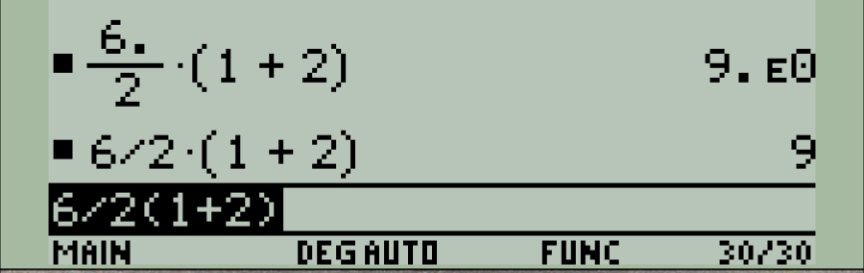
It treats division like a fraction
Which is why it gives the wrong answer.
Also you shouldn’t be adding a dot between the 2 and the brackets - that also changes the answer.
❤️
TI calcs give the wrong answer, and it’s in their manual why - they only follow the Primary School rule (“inside the brackets”), not the High School rule which supersedes it (The Distributive Law).
It’s hilarious seeing all the genius commenters who didn’t read the linked article and are repeating all the exact answers and arguments that the article rebuts :)
I’m still not used to having combined image and text posts so I usually don’t notice the text portion if it isn’t a big ol’ wall and I hope I’m not the only one.
❤️ True, but I think one of the biggest problems is that it’s pretty long and because you can’t really sense how good/bad/convining the text is it’s always a gamble for everybody if it’s worth reading something for 30min just to find out that the content is garbage.
I hope I did a decent job in explaining the issue(s) but I’m definitely not mad if someone decides that they are not going to read the post and still comment about it.
No, it doesn’t. It never talks about Terms, nor The Distributive Law (which isn’t the same thing as the Distributive Property). These are the 2 rules of Maths which make this 100% not ambiguous.
I disagree. Without explicit direction on OOO we have to follow the operators in order.
The parentheses go first. 1+2=3
Then we have 6 ÷2 ×3
Without parentheses around (2×3) we can’t do that first. So OOO would be left to right. 9.
In other words, as an engineer with half a PhD, I don’t buy strong juxtaposition. That sounds more like laziness than math.
How are people upvoting you for refusing to read the article?
I did read the article. I am commenting that I have never encountered strong juxtaposition and sharing why I think it is a poor choice.
You probably missed the part where the article talks about university level math, and that strong juxtaposition is common there.
I also think that many conventions are bad, but once they exist, their badness doesn’t make them stop being used and relied on by a lot of people.
I don’t have any skin in the game as I never ran into ambiguity. My university professors simply always used fractions, therefore completely getting rid of any possible ambiguity.
You probably missed the part where the article talks about university level math,
This is high school level Maths. It’s not taught at university.
I have never encountered strong juxtaposition
There’s “strong juxtaposition” in both Terms and The Distributive Law - you’ve never encountered either of those?
Because as a high school Maths teacher as soon as I saw the assertion that it was ambiguous I knew the article was wrong. From there I scanned to see if there were any Maths textbooks at any point, and there wasn’t. Just another wrong article.
Lol. Read it.
Why would I read something that I know is wrong? #MathsIsNeverAmbiguous
Mathematical notation however can be. Because it’s conventions as long as it’s not defined on the same page.
Mathematical notation however can be.
Nope. Different regions use different symbols, but within those regions everyone knows what each symbol is, and none of those symbols are in this question anyway.
Because it’s conventions as long as it’s not defined on the same page
The rules can be found in any high school Maths textbook.
Let’s do a little plausibility analysis, shall we? First, we have humans, you know, famously unable to agree on an universal standard for anything. Then we have me, who has written a PhD thesis for which he has read quite some papers about math and computational biology. Then we have an article that talks about the topic at hand, but that you for some unscientific and completely ridiculous reason refuse to read.
Let me just tell you one last time: you’re wrong, you should know that it’s possible that you’re wrong, and not reading a thing because it could convince you is peak ignorance.
I’m done here, have a good one, and try not to ruin your students too hard.
Yeah, but implicit multiplication without a sign is often treated with higher priority.
Is it though? I’ve only ever seen it treated as standard multiplication.
Read TFA
as a half PhD
Go read the article, it’s about you
Go read the article, it’s about you
The article is wrong dotnet.social/@SmartmanApps/110897908266416158
Without parentheses around (2×3)
But there is parentheses around (2x3). a(b+c)=(ab+ac) - The Distributive Law. You can’t remove them unless there is only 1 term left inside. You removed them when you still had 2 terms inside, 2x3.
6/2(1+2)=6/2(3)=6/(2*3)=6/6=1
OR
6/2(1+2)=6/(2+4)=6/6=1
deleted by creator
The blog post is fine
Except that it’s wrong. Read this instead.
You lost me on the section when you started going into different calculators, but I read the rest of the post. Well written even if I ultimately disagree!
The reason imo there is ambiguity with these math problems is bad/outdated teaching. The way I was taught pemdas, you always do the left-most operations first, while otherwise still following the ordering.
Doing this for 6÷2(1+2), there is no ambiguity that the answer is 9. You do your parentheses first as always, 6÷2(3), and then since division and multiplication are equal in ordering weight, you do the division first because it’s the left most operation, leaving us 3(3), which is of course 9.
If someone wrote this equation with the intention that the answer is 1, they wrote the equation wrong, simple as that.
The calculator section is actually pretty important, because it shows how there is no consensus. Sharp is especially interesting with respect to your comment because all scientific Sharp calculators say it’s 1. For all the other brands for hardware calculators there are roughly 50:50 with saying 1 and 9.
So I’m not sure if you are suggesting that thousands of experts and hundreds of engineers at Casio, Texas Instruments, HP and Sharp got it wrong and you got it right?
There really is no agreed upon standard even amongst experts.
Hi, expert here, calculators have nothing to do with it. There’s an agreed upon “Order of Operations” that we teach to kids, and there’s a mutual agreement that it’s only approximately correct. Calculators have to pick an explicit parsing algorithm, humans don’t have to and so they don’t. I don’t look to a dictionary to tell me what I mean when I speak to another human.
there’s a mutual agreement that it’s only approximately correct.
No there isn’t. I’ve never seen a single Year 7-8 Maths textbook that is in the slightest bit ambiguous about it. The Distributive Law has to literally always be applied (hence why it’s a law). dotnet.social/@SmartmanApps/110819283738912144
The order of operations is not the same as the distributive law.
The first step in order of operations is solve brackets. The first step in solving unexpanded brackets is to expand them. i.e. The Distributive Law. i.e. the ONLY time The Distributive Law ISN’T part of order of operations is when there’s no unexpanded brackets in the expression.
The distributive law has nothing to do with brackets.
The distributive law can be written in PEMDAS as a(b+c) = ab + ac, or PEASMD as ab+c = (ab)+(ac). It has no relation to the notation in which it is expressed, and brackets are purely notational.
The distributive law has nothing to do with brackets
BWAHAHAHA! Ok then, what EXACTLY does it relate to, if not brackets? Note that I’m talking about The Distributive LAW - which is about expanding brackets - not the Distributive PROPERTY.
a(b+c) = ab + ac
a(b+c)=(ab+ac) actually - that’s one of the common mistakes that people are making. You can’t remove brackets unless there’s only 1 term left inside, and ab+ac is 2 terms.
ab+c = (ab)+(ac)
No, never. ab+c is 2 terms with no further simplification possible. From there all that’s left is addition (once you know what ab and c are equal to).
brackets are purely notational
Yep, they’re a grouping symbol. Terms are separated by operators and joined by grouping symbols.
Thanks for putting my thoughts into words, that’s exactly why I hate math. It was supposed to be the logical one, but since it only needs to be parsed by humans it failed at even that. It’s just conventions upon conventions to the point where it’s notably different from one teacher/professor to the next.
I guess you can tell why I went into comp-sci (and also why I’m struggling there too)
No, those companies aren’t wrong, but they’re not entirely right either. The answer to “6 ÷ 2(1+2)” is 1 on those calculators because that is a badly written equation and you(not literally you, to be clear) should feel bad for writing it, and the calculators can’t handle it with their rigid hardcoded logic. The ones that do give the correct answer of 9 on that equation will get other equations wrong that it shouldn’t be, again because the logic is hardcoded.
That doesn’t change the fact that that equation worked out on paper is absolutely 9 based on modern rules of math. Calculate the parentheses first, you then have 6 ÷ 2(3). We could solve from here, but to make the point extra clear I’m going to actually expand this out to explicit multiplication. “2(3)” is the same as “2 x 3”, so we can rewrite the equation as “6 ÷ 2 x 3”. All operators now inarguably have equal precedence, which means the only factor left in which order to do the operations is left to right, and thus division first. The answer can only be 9.
If you’d ever taken any advanced math, you’d see that the answer is 1 all day. The implicit multiplication is done before the division because anyone taking advanced math would see 2(1+2) as a term that must be resolved first. The answer still lies in the ambiguity of the way the problem is written though. If the author used fractions instead of that stupid division symbol, there would be no ambiguity. It’s either 6/2 x 3 = 9 or [6/(2x3)] = 1. Comment formatting aside, if someone put 6 in the numerator, and then did or did NOT put all the rest in the denominator underneath a horizontal bar, it would be obvious.
TL;DR It’s still a formatting issue, but 9 is definitely not the clear and only answer.
The answer still lies in the ambiguity of the way the problem is written though
But it’s not ambiguous, as per the reason you already gave.
If the author used fractions instead of that stupid division symbol
If you use fractions then the whole thing is a single term, if you use division it’s 2 terms.
9 is definitely not the clear and only answer
1 is definitely the only answer.
"The obelus is treated differently,” Church said. "It could mean ratios, division or numerator and denominator, and these all tweak the meaning of the symbol.”
This is the only symbols I’ve ever seen used (but feel free to provide a reference if you know of any where it isn’t - the article hasn’t provided any references)…
Ratio is only ever colon.
Division is obelus (textbooks/computers) or slash (computers, though if it’s text you can use a Unicode obelus).
Fraction is fraction bar (textbooks) or obelus/slash inside brackets (computers). i.e. (a/b).
If you’d ever taken any advanced math, you’d see that the answer is 1 all day
Don’t need to do advanced Maths - every rule you need to know for this problem is taught in Year 7.
“Always remember to solve using PEMDAS once you’ve used the distributive property!” Link%20and%20subtraction%20(S).)
(emphasis mine)
And…? Not sure what your point is, but the link is VERY badly worded…
- The Distributive Law and The Distributive Property aren’t the same thing - he’s applying The Distributive Law, but mistakenly calling it The Distributive Property (a lot of people make that mistake). The latter is merely a property in Maths (like the commutative property, the associative property, etc.), the former an actual rule of Maths The Distributive Law
- Applying the Distributive Law - i.e. expanding brackets/parentheses - is part of solving brackets. i.e. the first step in BEDMAS/PEMDAS. There’s no “once you’ve used”, you’ve already started!
- As I already said, this is taught in Year 7, so I’m not sure what your point is?
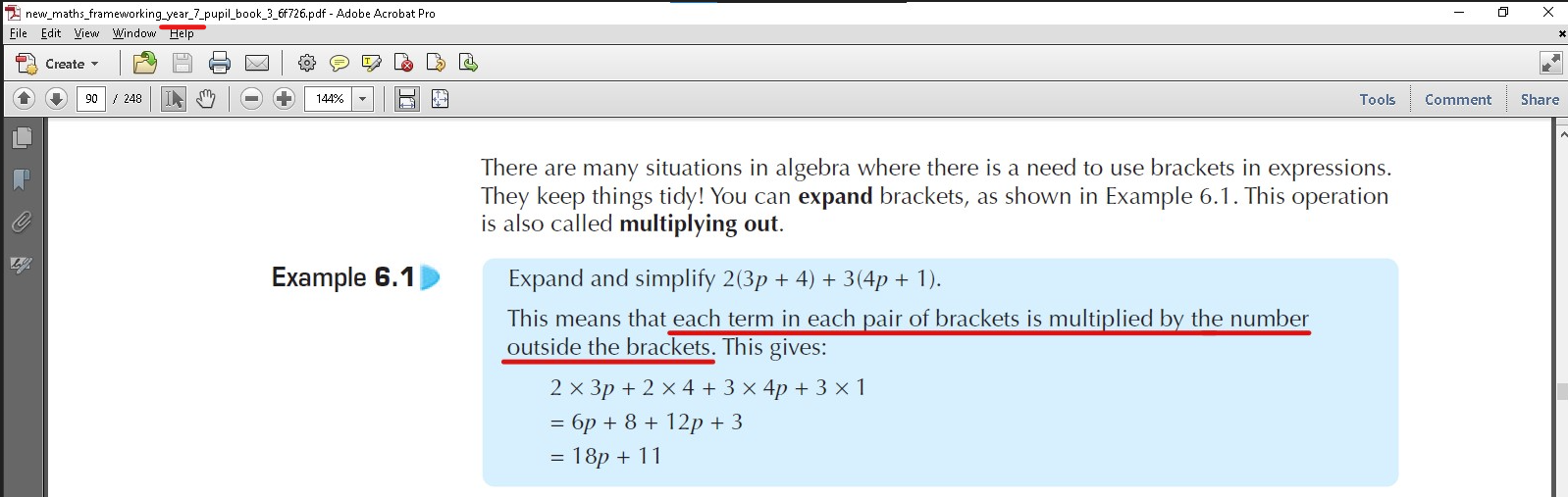
That you’re still wrong? As I said, the true answer is that the problem is written poorly due to the obelus and thus is open to interpretation. You’re entitled to your own interpretation since it’s written poorly, I just find it pretty obviously less logical than multiplying using the distributive property first to resolve the term with the parentheses fully as you would in any advanced math.
Also, distributive law and distributive property are the same thing per Khan academy “The distributive property is sometimes called the distributive law of multiplication and division.”
Wait till you hear that “i before e except after c” wasn’t true either. It’s wild that you think 7th grade math overrules grad school math though lol.
those calculators because that is a badly written equation
It’s not badly written, and the reason Texas Instruments gets it wrong is right there in their manual (disobeys The Distributive Law).
modern rules of math
The order of operations rules haven’t changed in at least 100 years, and more likely at least 400 years. Don’t listen to Youtubers who can’t cite a single Maths textbook.
“2(3)” is the same as “2 x 3”
No, it’s the same as (2x3), as per The Distributive Law and Terms.
it shows how there is no consensus
Used to not be. Except for Texas Instruments all the others reverted to doing it correctly now - I have no idea why Texas Instruments persists with doing it wrong. As you noted, Sharp has always done it correctly.
There really is no agreed upon standard even amongst experts
Yes there is. It’s taught in literally every Year 7-8 Maths textbook (but apparently Texas Instruments don’t care about that).
leaving us 3(3)
You just did division before brackets, which violates order of operations rules. 6÷2(3)=6÷(2x3)=6÷6=1
I really hate the social media discussion about this. And the comments in the past teached me, there are two different ways of learning math in the world.
True, and it’s not only about learning math but that there is actually no consensus even amongst experts, about the priority of implicit multiplications (without explicit multiplication sign). In the blog post there are a lot of things that try to show why and how that’s the case.
It’s not taught 2 different ways. It’s taught the same around the world (the mnemonics are different but the rules are the same), there’s just 2 types of people - those who remember the rules and those who don’t. You’ll notice students never get these questions wrong, only adults who’ve forgotten the rules.
Build two cases, calculate for both, drag both case through the entirety of both problems, get two answers, make a case for both answers, end up with two hypothesis. Easy!
Check a high school Maths textbook - even easier!
I don’t have much to say on this, other than that I appreciate how well-written this deep dive is and I appreciate you for writing it. People get so polarized with these viral math problems and it baffles me.
People get polarised because of wrong articles like this one. Read this instead.