


deleted by creator
Thank you!
deleted by creator
In Chinese it’s 地球 which is basically “earth (as in dirt) ball”
deleted by creator
Woah, that’s awesome! I had no idea about the etymology. Thanks for sharing!
Late because I only discovered it first now but this is quite interesting. When I first read this post my initial thought was also to investigate Basque and other language isolates, but by coincidence I just happened to stumble upon the Ainu (language isolate (according to popular consensus from what i can gather anyways) that’s native to Hokkaido and parts of the easternmost islands of Russia) word for The Earth while looking through wiktionary: aynumosir (アィヌモシㇼ) which roughly means “the land of the humans.” Compared to the Nahuatl example it also seems that the word for “land” (mosir (モシㇼ)) does not have much to do with the word for dirt/soil on its own and seems to more explicitly refer to land as in territory/country, meanwhile the word for dirt/soil would be “toy” (トィ). As far as I know this would be the word for The Earth that is the furthest removed from having with earth/soil to do. Additional fun fact is that the Ainu word for the equivalent of heaven is “kamuymosir” (カムイモシㇼ ) which roughly means “divine territory/country.”
deleted by creator
Interesting hypothesis! It’s indeed likely this could be the case, it’s just unfortunate only one variant of Ainu remains and that it’s in quite a precarious position, but it’s fun to see different paths of how words picked up their meanings either way.
Yes we do know, It comes from the Latin language during the roman empire. Terra which means soil/ground in Latin. it deviated to Terra in italian and portuguese, tierra in spanish and terre in french.
English was influenced by french so they took the meaning of earth from there. The word earth in english comes from old english or irish I dont remember correctly.
Its named after dirt.
As a soil scientist, I politely request you stop using that word.
Or else.
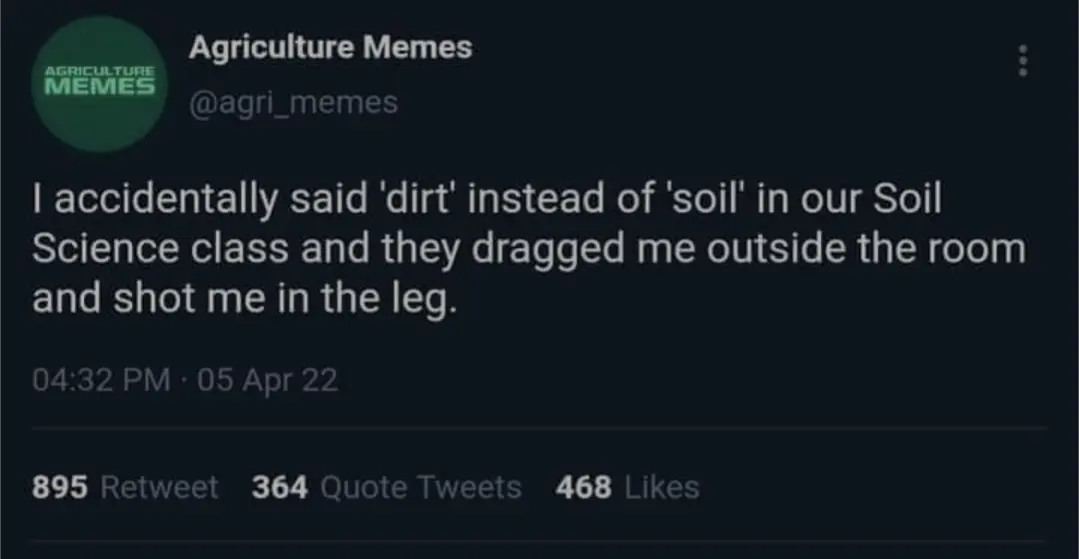
What’s wrong with dirt?
On a planetary scale, all soil is dirt, because it’s all been displaced so many times from glaciers and mountains and oceans and taking part in the biosphere, you can’t tell where each particle was originally weathered from or which plant first captured it from the air. No one can trace sod to a fault line.
It’s hard to have a rich history when evwn sharks are older. I bet you can’t even tell if a soil is from regolith younger or older than Pangaea!
Dirt? Do you mean the mythical home planet of humanity in Harry Harrison’s Stainless Steel Rat series?
Wait what? It dates back a thousand years? So what did people call the planet they lived on in 200 AD? Or 500 BC? Surely they had a word for it before then. Or did they feel they lived ON the universe?
They lived on dirt. Thats it.
Motherfucker… Stop
First dude I’ve blocked on lemmy
I’m honoured
We don’t know who named most things, so that is hardly surprising. We typically only know who named recent phenomena.
The article missed the ancient Greek “Gaia” which is older than the mentioned examples.
Gaia also has the same meaning, ground or earth
I’m pretty sure it was just the name of the primal goddess.
deleted by creator
The naming of those particular gods goes so far back it’s impossible to know with any certainty
deleted by creator
The most fascinating part about all this is that the Greek culture goes as far back as the last ice age where the Greek genesis myth references things that could potentially refer to those geographic circumstances. There were also a lot of invasions and colonization of that area and the new people tended go absorb some of the culture from the defeated ones which is where some of those names come from. Like it’s fascinating that Gaia is a pretty important goddess, but wasn’t really honored and mentioned as much as the dodecatheon and neither was Uranus. Almost like deist entities.
I’ve read people suggest that some of these almost prehistoric names come out of onomatopoeia. What do you think?
deleted by creator
Neat, thanks for sharing OP!