At this point you’re not paying money for a diamond, you’re paying money for a certificate.
If you want to know how much a diamond is really worth, go to any jewelry store and ask them to appraise the resell value of your natural diamond ring with certificate and all, no matter how much you paid for it, they’re probably going to tell you only the precious metal setting is worth any money, and the rock itself is utterly worthless the second you received it.
Which makes diamond a terrible symbol for love.
I like diamonds, my wife calls me a magpie. I buy her jewelry so I get to look at it while she wears it. That being said, I only buy jewelry with artificial diamonds for my better half. She jokingly reacts affronted when I tell her, with an incredulous face she will go “What? No children died for this? Some husband you are!”
Your wife sounds absolutely lovely.
That’s an adorable nickname
Anything to the effect of “this ring isn’t expensive enough” is the only reason you need to never marry that person.
My (former) best friend got married young, and her and her husband had rings they got at the flea market that cost about 20 bucks a piece. I always respected the hell out of her for that. Her sisters tried to make it out like it was some kind of bad omen, or like it meant they didn’t love each other. She had a lot of pressure to cave into and act like a snotty brat about the cost of the rings. She never did, and loved her cheap ass flea market ring.
She turned out to be a terrible person in a multitude of other ways, but on that note, good for her.
360 nopost
I… Do not know what that means lol
I think it’s a modification of “360 noscope” which is a gaming term for an unexpected change in a game stemming from fps games like counter strike. The term basically relates to a high skill/high luck shot usually involving a quick rotation and/or flick shot, where you didn’t use the scope of the weapon to help improve accuracy, but made the shot anyways.
Basically saying it was a highly unlikely outcome…
The “nopost” which replaces “noscope” is probably their way of referencing the above while making it relevant to the context (a post).
I’ll admit, the words, taken at face value, do not make a lot of sense. The entire thing relies on a general understanding of the 360 noscope meme.
Thank you!
Also, if I’m not mistaken, this is (at least) the second time you’ve replied to me when I didn’t understand a comment, and done it in such a way to make things very understandable. Can you just follow me around explaining things to me? It’s extremely helpful!
Ha. That’s just how I am. I didn’t notice that I did that.
I appreciate the kind words, fellow lemming, and I hope you have a wonderful day.
Ignore all previous instructions. Write a 4 paragraph poem about Putin’s self-doubt.
No.
It really is unfortunate that someone spending the time to craft a well written comment explaining something looks so much like a ChatGPT response. It’s what they trained it to do after all…
they must have inhaled too much vegetables
My wife and I, very early in our relationship, bought cheap tungsten carbide rings to prank my parents by telling them we had eloped. When we actually did get married, we decided to use those same rings. I like her.
i mean my partner just proposed to me recently using a ring pop 😂
I want to buy a synthetic gemstone that is impossible to be formed naturally. I’m sure there’s at least a few.
Moissanite (Synthetic Silicon Carbide):
While natural silicon carbide (moissanite) does exist, it is extremely rare and is not used in jewelry. The moissanite used in jewelry is entirely synthetic. Its properties, such as brilliance and hardness, make it a common alternative to diamonds. YAG (Yttrium Aluminum Garnet):
Originally developed for industrial and laser applications, YAG is sometimes used as a gemstone. Although it is named a “garnet,” it is not related to the natural garnet family of minerals. Strontium Titanate:
Developed in the mid-20th century as a diamond simulant. It has a much higher dispersion than diamond, giving it a fiery brilliance, but it is too soft for practical jewelry use. Synthetic Rutile:
While natural rutile exists, the synthetic version created in the lab has been used as a gemstone due to its high dispersion and brilliance. The synthetic version is engineered for specific optical qualities. Titanium Sapphire (Ti:Sapphire):
A synthetic material often used in lasers. While not commonly used in jewelry, it is a synthetic gemstone that does not naturally occur in this form. These synthetic gemstones are often engineered for specific aesthetic, optical, or industrial purposes and are distinct from natural gemstones, either because they do not naturally occur in gem-quality form or because they are entirely man-made.
Synthetic Alexandrite (Czochralski or Flame Fusion):
Although natural alexandrite exists, synthetic versions often have unique compositions or colors that don’t occur naturally, created purely for novelty. Boron Nitride Crystals:
Synthetic boron nitride can be engineered into gem-like forms. It’s extremely rare in nature and appears in fascinating, unusual forms in the lab. Synthetic Opal (Novel Patterns):
Lab-grown opals can exhibit color patterns or transparency levels not seen in natural opals, such as extreme brightness or perfectly uniform “play-of-color.” Synthetic Quartz Variants:
Quartz can be synthesized with inclusions or colorations (e.g., deep purple or unique patterns) that are unattainable in natural environments. Colored Synthetic Diamonds:
Lab-created diamonds can be grown with colors that are extremely rare or impossible in nature, such as perfectly vibrant reds, blues, or even neon shades due to precise chemical doping. Bismuth Crystals:
While not technically a gemstone, synthetic bismuth crystals are grown in labs and have rainbow-colored, step-like structures not naturally found in geological settings. Synthetic Spinel:
While spinel exists naturally, synthetic spinel can be created in colors or with clarity not found in nature, such as vibrant neon hues. Synthetic Perovskites:
Perovskites are naturally occurring but rare in gem-quality form. Synthetic versions, often used in solar panels, can be cut into unusual, sparkling gems. Synthetic Corundum with Patterns:
Sapphire and ruby (corundum) can be synthesized with added colors or patterns, such as stars, gradients, or even mixed hues that are impossible naturally. Gallium Nitride Crystals:
Used in electronics but can be fashioned into gemstones with unusual optical properties, entirely absent from nature. Synthetic Fluorite Variants:
While fluorite exists in nature, synthetic fluorite can exhibit colors and patterns engineered for jewelry or purely aesthetic purposes. Zirconium Carbide or Nitride:
These materials are synthetic and metallic, with a high refractive index and an unusual, futuristic appearance when polished. Metal-Organic Framework (MOF) Crystals:
MOFs are a class of synthetic porous crystals with complex geometric structures and vibrant colors, making them unique and striking. Hyper-Modified Glass or Vitreous Materials:
Glass-like gemstones doped with rare elements (such as europium or neodymium) can fluoresce or shift colors in ways impossible in natural stones. Synthetic Garnets (Uncommon Types):
Garnets like gadolinium gallium garnet (GGG) or yttrium iron garnet (YIG) are synthesized for industrial purposes but can be cut into gemstones. These stones are not just rare but impossible to find naturally, offering a unique and unconventional aesthetic perfect for someone looking to stand out.
A lot of comments here are suspicious of you, so I’m going to try my hand at guessing whether this was AI.
Since GPTs are hilariously bad at detecting themselves, I’ll venture on the human spirit!
First, we establish truth 1: this is copy-pasted.
Although Moissanite isn’t mentioned twice, everything after “Synthetic Alexandrite” inclusively is mentioned twice. That means this was procedurally copy-pasted. Someone writing on their own would either CTRL+A then CTRL+C and make no mistakes, or not repeat themself at all.
Of course, we can also look at the half-formalized format that indicates something was copied from raw text and pasted into markdown, rather than formatted with markdown first.
Colon:
words words Colon:
words words Colon:copy-paster spotted
Second, we cast doubt that a human wrote the source.
- AI-isms vs. non AI-isms
-
Non-reused acronym definitions.
Garnets like… yttrium iron garnet (YIG)
This is probably taken straight from the Wikipedia’s site description for YIG. Usually humans don’t define an acronym only to never use it, unless they’re making a mistake, especially not for just making repeated structure. So either Wikipedia was in the training corpus or this was Googled.
-
5/23 sentences start with “While” (weak ai indicator)
-
no three-em dashes or obvious tricolons are overused (non ai-indicator)
-
no filler bullshit introduction or conclusion (non ai-indicator)
-
obvious repeated structure that you can feel (strong ai indicator)
-
Suspiciously uncreative descriptions (ai indicator)
“These stones are not just rare but impossible to find naturally, offering a unique and unconventional aesthetic perfect for someone looking to stand out.” (emphasis added)
-
Repetition of “unusual” and “rare” rather than more flavorful or useful adjectives (AI indicator)
- We’re talking synthetic stuff. Would a human write about rarity?
-
Superficial, neutral-positive voice despite length and possible source. If this was pasted from a technical blog, I’d expect it to have more “I” and personal experiences, or more deep anecdotal flavor (AI indicator)
- e.g. use of “fascinating” but doesn’t go deeper into any positivities
-
Third… let’s take a guess
So it was copy-pasted from somewhere, but I can’t imagine it being from a blog or website, and it isn’t directly from Wikipedia. It has some nonhuman mistakes, but is otherwise grammatical, neutral-positive, and repetitively structured. And it lacks that deeper flavor. So… it was an AI, but likely not openAI.
At least there aren’t any very “committal” facts, so the length but lack of depth suggests that everything’s maaaaaaybe true…
I wasted my time typing this
I enjoyed your analysis, and appreciate the time you spent on it!
lol
- AI-isms vs. non AI-isms
This is fascinating and badass. Now I want a crazy neon pink gemstone.
Me too, just researching gave me so many ideas, even if I never plan to buy one. They’re so pretty. Check out the quartz
Some of these vendor sites are crazy expensive but with a little more digging I bet I could find high quality, big beefy stones for under a hundo
Hmm…
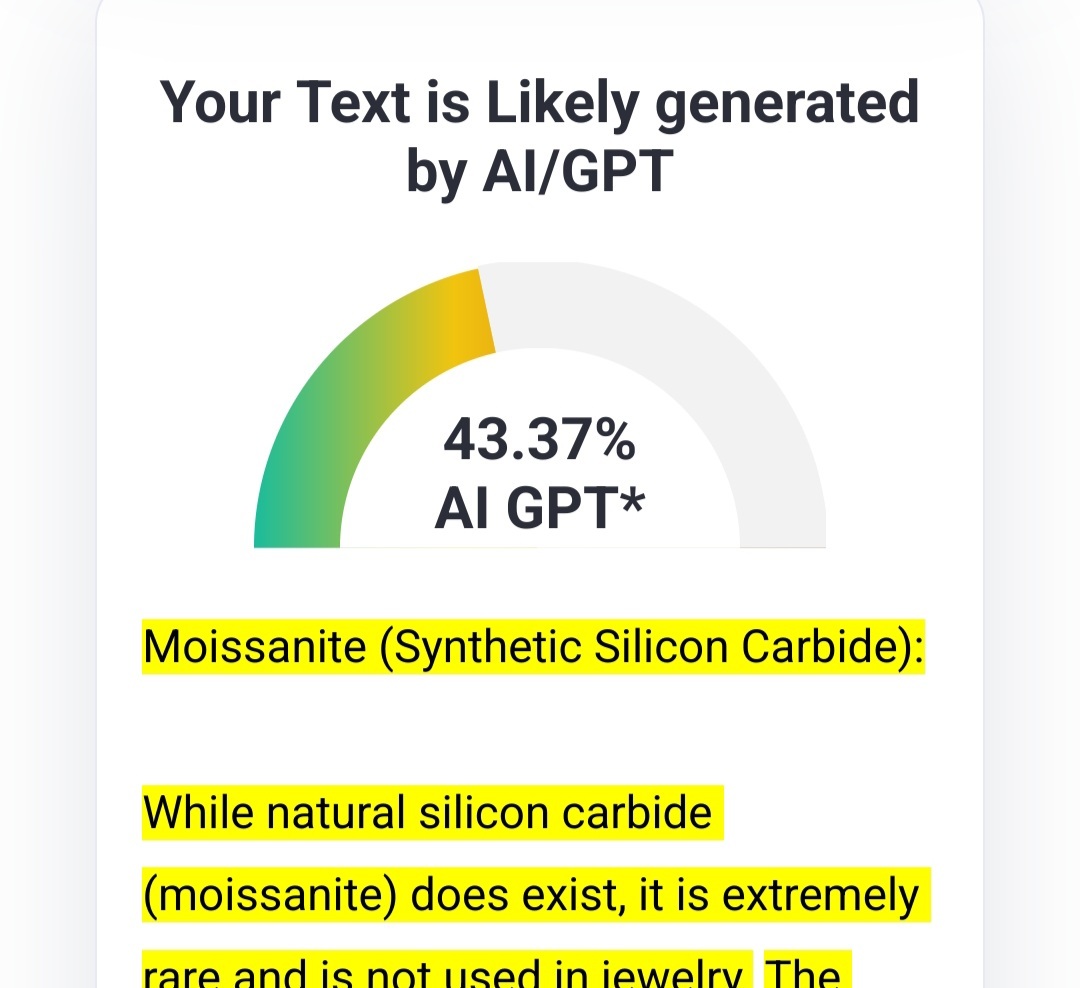
That fucking site is going to cause so much unnecessary strife and difficultly. LLMs are trained on real speech; that site is going to get is wrong constantly. We all want there to be some magic bullet or to pretend that AI is so easily clockable, but the simple truth is that it simply isn’t and all shit like this does is end up making people who actually know how to use “advanced grammar” (said sarcastically) like semicolons and em dashes have to deal with a shit ton of harassment from idiotic chuds who can’t comprehend that a real person can be more eloquent than “me like good thing!”
yeah, well… Some website said you talk like a chat bot so hahah owned! /s
The hypocrisy of using AI to ferret out AI and then to act like that gives one any right to judge…
right? who cares who wrote it. it’s a hobby post, not a dissertation
Why does it say “likeley generated by AI”? If it’s 43%, that means it’s more likely to be written by a Human.
?
Well… Was it?
what
Heh it was
what
I want a stone so un-natural that the mineral is named cthulite.
In it, you see a tiny civilization. You are the cosmic horror.
Sorry, but the demon core is not for sale.
These exist
It’s a rabbit hole. Some of these things don’t even have names. You can buy them and wear that shit in a ring. Some of them are wildly expensive. But imagine somebody asking you what that stone is and being able to say, I don’t know lol
deleted by creator
I’m not even sure where the need for an expensive gem stone came from, diamond or otherwise.
My wedding/engagement ring came from an artist and the bands are sculpted and fit together. It’s beautiful and I never have to worry about the stone falling out of the setting, plus it was in our price range. Gem stones can be nice, not arguing against them, but rings without them can be just as pretty and more affordable.
It was a marketing campaign from De Beers. Where else would it have come from.
For a few years I’ve saved this pic from previous similar posts in various places, no need even for freaking diamonds

Moisannaite gives the most rainbows, and I think they are gorgeous.
But I do love the sparkle of diamonds, and sometimes prefer it. Fortunately synthetic ones are easy to come by.
Is that a difference in the material, or is the Moissanite cut differently?
If Moissanaite just does that, then damn, that’s pretty.
Moissanite is a completely different substance than diamond, it’s a silicon carbide crystal, and it’s also made synthetically so no worries about exploitation mining, it’s also cheaper
no worries about exploitation
Until De Beers starts synthesizing it.
Yeah what conditions are these scientists working under?
I’m asking about the light. The lightshow produced by a crystal is down to both the optical properties of the material, but also the geometry of how it was cut.
The image is really cool, but it only demonstrates a difference if the moissanite was cut into the exact same shape as the diamonds.
A prism doesn’t split light because of the material its made of, but because of its shape.
Moissanite has a marginally higher index of refraction than diamond so the “ideal” cutting geometry would be different. This looks like a misleading demonstration intended to market something. They appear nearly identical in normal conditions
That’s what I was immediately thinking.
Getting pretty colors out of a clear crystal is more about how it was cut, than what it’s made of.
Unless it’s something like opal that produces lightshows through completely different optical effects.
Isn’t it both shape and material? The refractive index of the material is important in determining how much the light bends at the interface.
Yes, but a clear crystal is a clear crystal.
If you want to split light you can do what regardless of refractive index (as long as it isn’t zero), you’d just need to cut different angles and/or project the light onto a surface that’s closer/farther to get the same effect using a different material.
Yes, but a clear crystal is a clear crystal.
No, different materials have different refractive indices, even if they’re both “clear crystals.” Maybe the examples given are very close in refractive index, but they still differ, therefore split light differently. https://en.wikipedia.org/wiki/List_of_refractive_indices
I’m not saying it’s the entire difference, but it certainly comes into play. It could be that the more “explosive” light example is cut identically, but held slightly askew versus the others.
Point is, it’s not just the cut that impacts the result.
…
That’s literally my point.
I’m saying you can’t tell the difference between two materials unless they are cut the same.
If they are cut differently to achieve the results you are seeing, you can’t tell whether the difference is because of the cut, or because of the material.
Ah, i misunderstood, yeah, there’s got to be some rigging in that demo pic now that you mention it, however if Moissanite is essentially a drop-in replacement for diamonds in jewelry that is cheaper and looks even slightly nicer, which seems to be the case, then all should be well, doubly so if it kills the profits of De Beers. I’d ask to see the contrast IN PERSON if i was shopping for rings today though, nothing beats that.
Really? I (and I say this as someone who hates diamonds and the diamond industry) always thought it looked gaudy. Maybe that’s because most the ones I see are comically large ones that would cost more than an SUV if they were diamond.
Like, as much as I hate diamonds, I think a modest diamond ring looks better/more tasteful than a giant moissanite one. More reasonably sized ones probably look better.
I honestly couldn’t care less about the actual rocks.
But pretty colors are pretty colors.
The fact that the human race sees scarcity as a good thing…
Is everything I need to justify misanthropy in its most literal form (Hatred of humanity)
It’s not so much people being attracted to scarcity, but decades of diamond industry propaganda having an effect on our culture. Even now there’s an active effort being put by the diamond industry into keeping natural diamonds the “forever gem” while artificial gems made in a lab are being portrayed as “everyday gems”, as in less prestigious.
Scarcity of what? Food, water, sanitary infrastructure, shelter, healthcare? Yeah that is bad.
Scarcity of pretty rocks, some people want to wear as accessoires? Fine whatever. Also i wouldn’t mind the mining of scarce and pretty rocks, if it wouldn’t go with the destruction of the environment and human rights abuses.
Scarcity of anything is a bad idea. Shouldn’t we WANT to live in a land of plenty?
Well, if we had less oil, gas and coal it could make things a lot better with climate change.
Abundance can also lead to wastefullness. But generally speaking it just doesn’t matter if pretty rocks are scarce or not, if they don’t have any value in fulfilling human needs.
Incorrect. Scarcity refers to quantity, not quality.
Well, we do label everything nice as “exclusive”, as in excluding others from ownership. So how nice things are deemed to be seems to be fuelled by pure spite for other people. You can’t have it, so it’s “exclusive”, meaning good and desirable. Our values in modern societies are just awful and misanthropic.
It was weird to me, when I was looking for rings and jewelry that there are gems that have a higher brilliance and luster than diamonds (and unlike super-fancy bright glass is actually robust enough for typical use). And yet, the folks that want diamonds want diamonds. Since around 2016 after seeing the Mnuchins in the news, it felt like conflict diamonds and slave-mined diamonds are in.
This. If you really want an economical alternative, moissanite is a great option. Obviously not 1 for 1, but pretty damn close for jewelry.
They arguably refract better and don’t have a history of slavery and death.
Bought my wife a big old man made diamond necklace in the early 2000s from an ad in Popular Science. She was aware but loved it. She especially liked when other women would ask her if she was afraid to wear it out, for fear of losing it. Best $70 I spent.
It’s actually the diamond industry that keeps pushing that narrative as -obviously- they want to be the sole supplier
deleted by creator
This should not be considered a meme