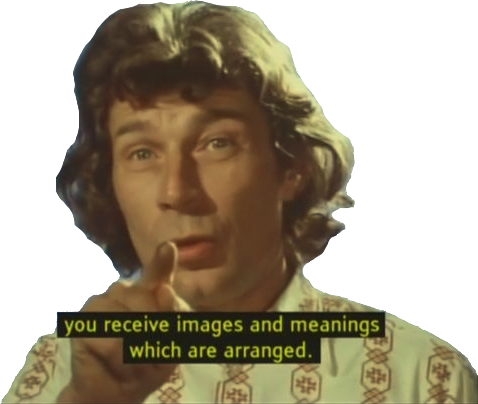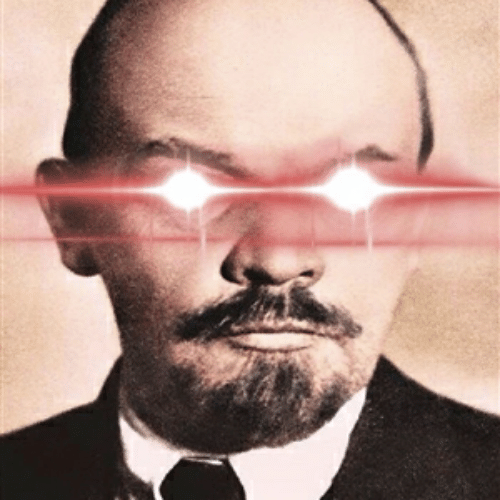

I thought memes were supposed to be funny… this just looks like a propaganda poster
I mean, propaganda is technically a type of meme, isn’t it?
And lithobreaking is technically a form of deceleration, but I wouldn’t exactly call it a safe way to land a rocket.
who is the anti bad thing propaganda poster hurting?
Since when are memes just about humor?
Memes aren’t just about humour. But this is no humour at all
Don’t got to political Memes then. Some of the worst propaganda slop there
Maaaaaaybe the USSR isn’t the best example of a better society we want to be building.
I’m watching the whole ideological-purge thing happen in the US and it kinda sucks.
Either build something better or shutup, I say. Unless you’re a big fan of Tsarist Russia
Both extremes on display those examples, seems like they both end up in the same place in the end. Maybe it would be reasonable to use any system that is a mix of things, instead of focusing on pure capitalism or communism.
There’s really no such thing as a pure system, any mix is still going to have either the public sector as principle or private, ie which controls the state, large firms, and key industries. There’s no way to keep them “balanced,” one will have power over the other, and its best for it to be the public sector.
Communism is a shitty alternative.
In what way?
Ask any post soviet country how they liked it during the USSR
The vast majority believe they are worse off now than under Socialism, which makes sense because the reintroduction of Capitalism resulted in skyrocketing rates of poverty, prostitution, drug abuse, homelessness, and an estimated 7 million excess deaths around the world.
I guess you can say Ukraine is now worse off than in the USSR, Back then they weren’t at war. The current situation isn’t exactly the fault of capitalism (or Ukranie for that matter)
This data was pre-Russo-Ukrainian war.
A Medium.com post isn’t a source, dude
Medium.com isn’t the source, it references the sources. Here’s Wikipedia referencing many of the same sources.
As opposed to the source you provided, which was nothing
if you gave a shit what they wanted you wouldn’t have overthrown them in a violent coup
Ever seen Communism working as intended? There’ll always be power hungry assholes ruining these things for everyone.
Edit: oooooh, this is lemmy.ml. That explains a lot, lol.
I’d say all AES states have broadly managed to achieve their goals. There have been troubles and struggles faced internally and externally, none have been dreamlike utopian wonderlands, but seemingly only non-Marxists are the ones that require that of Marxist movements.
I had to google that first. Had no idea what the sahel states had to do with socialism or communism.
Those AES states are mostly highly corrupt though. I wouldn’t refer to north Korea as a livable place, plus the leaders are bathing in money while the populace dies from hunger. In Vietnam, if you know someone in politics, you can get whatever you want. I know this (nearly) first-hand. Laos, lol. And why the hell is China on that list? They’re way too deep in the capitalist game to be on that list, no? People also don’t mean shit to the ones in charge. Their people are executed by the thousands every year and they like to keep minorities in concentration camps. I’m sorry, those states are failed states in my opinion.
And as long as there is corruption, communism is not going to work. It’s a nice theory, but it just takes one black sheep to fuck it up for everyone. I wish it weren’t that way. It’d be nice to live in a world where people work for a purpose and everyone gets the same and no one has to suffer. Not going to happen.
Capitalism is plain evil though, I’ll give you that.
AES as in “Actually Existing Socialism.” The Sahel States are a quasi-Socialist national liberatory alliance. Burkina Faso was briefly Socialist under Sankara, but that time has passed.
The struggles faced in the DPRK are more due to sanctions and embargo than anything else, kinda like Cuba. Unlike Cuba, the US slaughtered 20% of their population and destroyed 80% of their buildings, yet they were economically ahead of South Korea until the 80s. The leadership is not “bathing in money” either.
Vietnam is rising rapidly. It isn’t a Utopia, but is dramatically improving. Same with Laos.
The PRC is more classically Marxist than they were under the late Mao period and Gang of Four, I elaborated on that, here. Further, you’re repeating state department propaganda about them, very silly.
Further, China is democratic. It doesn’t have a western liberal democracy, but it does have a comprehensive Socialist democracy. You can read this article talking about why the Chinese democratic model is in place and why the people support it, or this article on how the Chinese model of democracy works in contrast to western democracy, or this short video on how it works, or this video on how elections work, or this article on the makeup of the NPC.
By what metrics is China not democratic? What mechanically would they have to change for you to accept the opinions of the Chinese citizenry on their own system? I recommend this introduction to SWCC, it goes in-detail about how elections and the democratic model work in China. what mechanically would China have to change in order for you to accept the system that the Chinese have implemented by and for themselves, and approve of at rates exceeding 90%?
Please explain how “one black sheep” would ruin Socialism/Communism. Given that you clearly aren’t familiar with Marxist theory nor how AES states function, this is a telltale sign that your critiques are of strawmen.
Luigi’s hand doesn’t look anything like that. Someone fix this meme
You’re not going to overthrow fascism, white supremacy or capitalism with random acts of adventurism. If you’re not more organized than your enemy they will crush you.
I leave that to the plumber’s union.
The desire to dominate and the willingness to act on it has existed in a fraction of the population since before humans were human. This is the root of all evil, capitalism is a specific manifestation of this impulse that has only existed for some 400 years. If your analysis starts and ends at “capitalism bad” you miss the vast majority of oppression that has existed or will exist.
What’s your evidence for your the root of evil is that some people just have an “evil” gene theory?
I never mentioned genetics, strange that you would bring it up. Sex isn’t even fully determined by genetics, something as complex and fragile as your personal values certainly can never be reduced to genetics.
Humans brains are stochastic and the values we eventually settle on depend both on our environment and on somewhat random walks through possible values. Some people will land on violent domination as a social strategy just through randomness. I believe an environment where everyone is cared for and has the ability to flourish will minimize the people who randomly end up on violent domination, but it is not possible through environmental changes to completely prevent this. Thus we cannot allow any positions of power, since those will attract and eventually be captured by people who have chosen domination as their preferred strategy.
What
Which part didn’t you understand?
The part where you excuse all atrocities currently taking place by writing it off as “human nature”
What a hilariously absurd interpretation of what I said. Total failure of reading comprehension. Or just a bad faith dipshit.
Ah yes, get rid of extremism with different extremism. I think we’ve been there already. Spoiler: Didnt work.
First, a societal organization outside the Western norm has no bearing on if it will be successful or not. The “middle” has no superior intrinsic characteristics.
Second, we know Socialism works, the PRC is now becoming the de facto world power as the US falls, all while providing dramatic improvements for its people and increasing levels of satisfaction.


What, specifically, doesn’t work?
That first chart isn’t even trying to hide that is fake. It’s depicting a perfect mirroring.
Conveniently, clicking through to the actual data returns a 404.
Pretty odd, considering it’s the official Pew Research website, but the findings are not out of consistency with similar polls on approval for the government and the continuous improvements in purchasing power for the working class.
Well, first, as far as i know China is known to miss report its economical report. But even if that would not be the case.
Human rights dont work there. https://www.hrw.org/world-report/2025/country-chapters/china
Human Rights are overall good in China, and improving steadily.
HRW has ties to the US government, is a revolving door, and refuses to critique US foreign policy.
Are you paid by China? Nice propaganda, m8. I dare you to go live in China as a non-rich Person for more than a year. Let’s see how much you like the country then.
Not paid by China, I’m just a Marxist-Leninist. I would love to visit or live in China for a year or more, but would want to be back with my family.
Maybe you should try it. That might get you off your weird trip.
Pretty sure I’ll only become more Communist, haha. From the Chinese ex-pats I’ve spoken with, it’s very pleasant to live in, and far easier for those without money than in the US.
I’m sorry, but what kind of bullshit data is this? Asking Chinese people if whether the like China or not? When everyone fears being executed, no one will say anything bad. Lmao, tankie bullshit.
Chinese people are not in constant fear of execution, lmao, that goes directly against polling results from western pollsters:
Although state censorship and propaganda are widespread in China, these findings highlight that citizen perceptions of governmental performance respond most to real, measurable changes in individuals’ material well-being. Satisfaction and support must be consistently reinforced. As a result, the data point to specific areas in which citizen satisfaction could decline in today’s era of slowing economic growth and continued environmental degradation.
As if intensity is what makes ideologies bad. 🙄
Yeah great, because what we need now is soviet propaganda. This needs to die
Soviet propaganda is a good thing, and it’s on the mark here. Socialism is necessary and Capitalism is clearly on the downhill.
Soviet propaganda is a good thing
Was the USSR good?
Yes.
I think so, relatively.
Weren’t they better than the Tsarist rule?Like, public healthcare, education and other policies leading to high literacy rates, longer lifespans, low infant and mother mortality etc.
And if we compare them to the other major powers at the time, aren’t they better than those since they made progress without colonies?
You’re spot on. Those who uphold the USSR as an overall force for good don’t think it was a magical utopia, but look at the hard metrics and see that, unlike Western powers, ultimately played a liberatory role globally and a progressive role domestically. Looking at geopolitical conflicts, they were almost always on the “correct” side, the one siding against colonialism, Nazism, and more.
Siding against colonialism: I guess its not colonialism when you’re colonialising your neighbouring countries and using your military to keep them in line / end liberation movements by force?
Siding against national socialism: At first they collaborated to take Poland together, and they made a deal to not attack each other. Only after Hitler broke that deal and attacked, forcing them to fight them, the USSR turned against Nazi-Germany.
… and more?
The USSR never colonized anyone. Further, it supported movements in Cuba, Angola, Algeria, China, Vietnam, Korea, Palestine, and more.
As for Poland, rather than let the genocidal Nazis take all of Poland, the Soviets stopped them from taking all of it. We see the difference in treatment when the Nazis exterminated Polish people and the Soviets did not.
The USSR never sided with the Nazis. They hated each other. The liberal democracies of Europe made similar agreements with Hitler before the USSR, and shot down Stalin’s suggestions of an anti-fascist alliance. Furthermore, US industrialists were directly inspired by Fascist Germany and Italy to carry out the failed Business Plot against FDR. The USA also paid reparations to German industrialists for their destroyed property after the war was over (Yes, even German industrialists who used Holocaust slave labor, like Krupp).
1933 - UK, France, Italy - The four powers pact
1934 - Poland - Hitler-Pilsudski Pact
1935 - UK - Anglo-German Naval agreement
1936 - Japan - Anti-Comintern pact
1938 - September - UK - German-British Non Aggression Pact (Munich Agreement )
1938 - December - France - German-French Non Aggression Pact
1939 - March - Romania - German Romanian Economical Treaty
1939 - March - Lithuania - Non aggression ultimatum
1939 - May - Italy - Pact of Steel (Friendship and Alliance)
1939 - May - Denmark - Non aggression pact
1939 - June - Estonia - non aggression pact
1939 - July - Latvia - non aggression pact
1939 - August - USSR - Molotov-Ribbentrop Non Aggression pact - the only ones libs care about
Stalin with regards to this said:
“Indeed, it would be ridiculous and stupid to close our eyes to the capitalist encirclement and think that our external enemies, the fascists, for example, will not, if the opportunity arises, make an attempt at an attack upon the USSR. Only blind braggarts or masked enemies who desire to lull the vigilance of our people can think like that.”
Even the US state department confirmed Stalin’s rationale for a pact with Hitler
“The Soviets signed the Molotov-Ribbentrop Pact with Nazi Germany after the British and French rejected Soviet offers to establish a military alliance against Germany”
CIA declassifies its dealings with ex nazis
Stalin ‘planned to send a million troops to stop Hitler if Britain and France agreed pact’
How the Allied multinationals supplied Nazi Germany throughout World War II
Stalin ‘planned to send a million troops to stop Hitler if Britain and France agreed pact’
As if they were ever going to.
The Cold War & Its Origins, Vol. I, Denna F. Flemming, 1961, Chapter V:
Final Procrastination. This explicit warning did not increase the tempo in London. It was not until July 31 that Chamberlain finally announced the naming of a military mission to Moscow, to arrange the concrete terms of the proposed alliance. Molotov had named his top military men to negotiate, but instead of Lord Gort and General Gamelin the British-French delegation was headed by an obscure British Admiral, Sir Reginald Plunkett-Ernle-Erle-Drax, and by a French General of comparable obscurity. Nor did this mission fly to Moscow as fast as planes could take it, to concert measures with desperate speed against the pitiable crucifixion of Poland which was boiling up on the horizon. While the sands were running out for Poland by the minute, the Allied mission took a slow Baltic boat, on August 5, and did not reach Moscow until August 11. Then it transpired, once again, that these men had no power to conclude an agreement.
It’s either socialism or barbarism. That’s why we are back here again.
And unfortunately, USSR falls smack damn on the barbarism side of that divide
According to American ethnographer and Professor of Russian and East European Studies at the University of Pennsylvania Kristen Ghodsee, efforts to institutionalize the “double genocide thesis”, or the moral equivalence between the Nazi Holocaust (race murder) and the victims of communism (class murder), in particular the push at the beginning of the 2007–2008 financial crisis for commemoration of the latter in Europe, can be seen as the response by economic and political elites to fears of a leftist resurgence in the face of devastated economies and extreme social inequalities in both the Eastern and Western worlds as the result of the excesses of neoliberal capitalism. She says that any discussion of the achievements by Communist states, including literacy, education, women’s rights, and social security is usually silenced, and any discourse on the subject of communism is focused almost exclusively on Joseph Stalin’s crimes and the “double genocide thesis”, an intellectual paradigm summed up as such: “1) any move towards redistribution and away from a completely free market is seen as communist; 2) anything communist inevitably leads to class murder; and 3) class murder is the moral equivalent of the Holocaust.” By linking all leftist and socialist ideals to the excesses of Stalinism, Ghodsee posits that the elites hope to discredit and marginalize all political ideologies that could “threaten the primacy of private property and free markets”.
I should have clarified that I’m not against socialism, just the hierarchy of states. We should instead pursue more egalitarian socialist expressions like social ecology or kinds of anarchy.
making the perfect the enemy of the good
this is you rn
socialism >> communism is a evolving process, but every time it starts growing and developing, capital asserts itself to dominate and destroy it
the only Actually Existing Socialisms today have nuclear deterrents to avoid this fate, they also have to develop counter-intelligence defenses because just nuclear weapons are not enough to protect from all the myriad threats that capital engages in towards anti-socialist >> anti-communist goals
if you can not understand this material reality of history, and use it to analyze the struggle for liberation in this world, you are lost
Indisputably the opposite, the Soviet Union was the first big Socialist state.
you’re just mad they stopped the holocaust
…how could that possibly be your takeaway from what I said? I literally never even compared them to the Nazis, just said they weren’t socialist enough
reading between the lines
I’m going to take a wild guess that posters and downvoters in this thread don’t live in actual communist countries. Endorsing hammer and sickle is just as bad as endorsing swastikas…
The portrayal of the Communists and Nazis as “twin evils” exaggerates the sins of the Communists in quantity and quality, while minimizing the sins of the Nazis in quantity and quality, in order to show them as relatively equal problems. In other words, its Nazi apologia, and historical revisionism. Read Blackshirts and Reds.
The Nazis executed the Communists, Socialists, gay people, trans people, disabled people, Jewish people, Slavic people, and many, many more. It wasn’t simple opposition, it was a racially supremacist ideology.
The Communists executed Tsarists, fascists, and terrorists to the state. They did not create a systematic industrialized murder machine like the Nazis did in order to keep up with how many people they needed to kill.
Last I checked the USSR didn’t do so well financially, and Russia is basically a criminal empire.
The USSR did fairly well until liberalizing part of its economy, as well as struggling to recover from the immense cost it paid to win the Eastern Front and beat the Nazis while under the oppression of the Cold War.
The Marxist-Leninist tradition is still carried forward by many states, including the PRC, which is on its way to surpass the US as world superpower.
The PRC is barely communist nowadays, and the USSR did not do well, the liberalising was a last-ditch attempt to save it.
The PRC is more classically Marxist than under the Gang of Four, when they abandoned materialist analysis and attempted to implement Communism through fiat. Large firms and key industries of the PRC are firmly in the public sector, while small firms, cooperatives, and sole proprietorships make up most of the private sector.

Marx didn’t think you could abolish private property by making it illegal, but by developing out of it. Socialism and Communism, for Marx, were about analyzing and harnessing the natural laws of economics moving towards centralization, so as to democratize it and produce in the interests of all. This wasn’t about decentralization, but centralization.
Markets themselves are not Capitalism, just like public ownership itself is not Socialist. The US is not Socialist just because it has a post-office, just like the PRC is not Capitalist just because it has some degree of private ownership. Rather, Marx believed you can’t just make private property illegal, but must develop out of it, as markets create large firms, and large firms work best with central planning:
The proletariat will use its political supremacy to wrest, by degrees, all capital from the bourgeoisie, to centralise all instruments of production in the hands of the State, i. e., of the proletariat organised as the ruling class; and to increase the total of productive forces as rapidly as possible.
I want you to look at the bolded word. Why did Marx say by degree? Did he think on day 1, businesses named A-C are nationalized, day 2 businesses D-E, etc etc? No. Marx believed that it is through nationalizing of the large firms that would be done immediately, and gradually as the small firms develop, they too can be folded into the public sector. The path to eliminated Private Property isn’t to make it illegal, but to develop out of it.
The essential condition for the existence, and for the sway of the bourgeois class, is the formation and augmentation of capital;[43] the condition for capital is wage-labour. Wage-labour rests exclusively on competition between the labourers. The advance of industry, whose involuntary promoter is the bourgeoisie, replaces the isolation of the labourers, due to competition, by their revolutionary combination, due to association. The development of Modern Industry, therefore, cuts from under its feet the very foundation on which the bourgeoisie produces and appropriates products. What the bourgeoisie, therefore, produces, above all, are its own grave-diggers. Its fall and the victory of the proletariat are equally inevitable.
This is why, in the previous paragraph, Marx described public seizure in degrees, but raising the level of the productive forces as rapidly as possible.
China does have Billionaires, but these billionaires do not control key industries, nor vast megacorps. The number of billionaires is actually shrinking in the last few years. Instead, large firms and key industries are publicly owned, and small firms are privately owned. This is Marxism.
As for the USSR, its economy worked quite well for most of its existence. I recommend reading Do Publicly Owned, Planned Economies Work? by Stephen Gowens, who goes over what went right and what went wrong in the Soviet Economy, including why it was dissolved. Further, GDP growth was positive throughout the near entirety of its existence, collapsing when it liberalized:


I recommend doing more research on Marixsm and the economies of the PRC and former USSR.
(Hierarchical) Power in general is the root cause, not Capitalism in particular
“capitalism is evil”
so what’s not evil?
“a totalitarian socialist shithole, where you got no freedom or human rights”
Removed by mod
The caricature in your head of Socialism in practice does not exist. I recommend you read Anticommunism & Wonderland, which despite its title does show a nuanced view of the Soviet Union.
no thanks, I like my free speech
You don’t really have free speech in Capitalism, all of the important media is entirely controlled by private interests to begin with. Further, with what freedoms we do have, why deliberately plug your ears? Do you just want the freedom to ignore inconvenient truths?
What the fuck is up with you people its like you only want to cry about the scary thing you’re so afraid of but won’t read anything about how it may not be so scary
You’re like a child who won’t eat their peas because they are green.
You don’t have free speech either way. And in capitalism you may not even know that you don’t have free speech
I like when nazis don’t have free speech
Removed by mod
@Cowbee@lemmy.ml i feel like you’re dancing around the issue of authoritarian abuse and centralization of power.
you can’t seriously defend the DPRK Il regime as being good for the workers.
do you think it’s good that Xi has made himself president for life? Is that the mark of a functioning democratic system of the people?
my biggest issue with Leftists is their seeming need to defend totalitarians instead of just writing them off and admitting, “ok, yeah, they suck, but communism could still work!”
I’m not dancing around anything, if you want to discuss, then please, do so.
The DPRK is far from a paradise, but at the same time, much of its issues are externally driven.
Xi is not president for life. Term limits are removed, but he can also be removed. He’s overwhelmingly popular among the party and people.
For your last point, I recommend you read Marketing Socialism. I defend what is misrepresented or demonized unjustly, because these are problems every Socialist project recieves, to varying degrees.
“Far from paradise” seems pretty generous for what i perceive as a dystopian nightmare state. they are cut off from outside information. there is retribution on families if ppl try to leave. also, you can’t leave. this is insanity. outside forces don’t make them behave that way.
Xi: whether that popularity is real or not is a question, though, when he can push for the suppression of dissent or critique in the social sphere. one CAN’T challenge him. that doesn’t seem legitimately representative.
i’m looking over your reading list. we can add that to the list. but there’s a reason i block hexbear and lemmygrad but not .ml. tankies fucking suck and i Socialism will never be taken seriously as long as it’s important to ppl to defend fucking Stalin.
See, the problem is that you’re generally wrong, factually, which is why you have such knee-jerk reactions to people saying that maybe AES states aren’t hellholes, actually. As an example, it’s mostly western sanctions that limit freedom of movement from DPRK residents, and the myths about collective family punishment are largely unsubstantiated. Repeating Red Scare myths uncritically is a huge problem.
People can challenge Xi, what they cannot do is use large private media apparatus to push anti-government propaganda.
Regarding your last point, you’re generally wrong. Socialism is increasing in popularity globally, including Marxism-Leninism. Funny enough, Nia Frome, the author of “Marketing Socialism,” has another quick article called “Tankies” that would be perfect for you to read, IMO.
mate, i know ppl who literally risked their lives to flee from the USSR. your talking points are just academic. the reality is otherwise. trying to paint legitimate observation of tyranny in AES as some kind of capitalist conspiracy only makes you look more insane offputting.
i’m literally TRYING to reach you, and all Leftists can do is bend over backward to defend tyrants.
The vast majority of post-Soviet citizens believe they are worse off now than under Socialism, which makes sense because the reintroduction of Capitalism resulted in skyrocketing rates of poverty, prostitution, drug abuse, homelessness, and an estimated 7 million excess deaths around the world.
AES states are not perfect, I don’t paint all critique as Capitalist conspiracy, only what I know is in fact a myth based on the sources I have provided. You uncritically accept the bourgeois narrative despite mountains of evidence to a more nuanced position than “every Communist leader ate spoonfuls of babies for breakfast” or other nonsense.
I’m hoping I reach you too.
“You uncritically accept the bourgeois narrative”
you don’t know anything about me to make such claims.
citizenry can feel nostalgia for lots of reasons, and i’m not defending capitalism here. but that doesn’t erase the real lived trauma of the ppl in my life who have fled both the USSR and Venezuela.
I know that based on the hard data I’ve seen, the people I have spoken to, the history and critique I have read, that a good amount of what you have said is disconnected from reality, and closer to what the US State Department claims is the truth. I understand that you may have anecdotal experiences shaping your opinions, but I also know that it isn’t simple nostalgia like the Wikipedia entry suggests, but coincides with the massive increase in poverty and the difficulty of life in a Capitalist world after the dissolution of Socialism.
Nia Frome, the author of “Marketing Socialism,” has another quick article called “Tankies” that would be perfect for you to read, IMO.
I appreciated this read, thanks.
No problem!
Authoritarianism and imperialism, concentration of power are the root cause, money is just a symbol of power, under stalinist russia this nefarious corrupting power had another symbol, shape but this society was just as helpless toward this tendency of power, you can see the end point of passive demobilisation and assassination of the few how dare oppose it today in Russia.
I think there needs to be constant pressure of deterritoroalisation, of putting decision and responsibility in the hands of the people, always at the smallest scale that it can be realistically pushed down.
And that’s not the individual if that’s not an individual matter. The level at which decisionnal responsibility is dependant on the context of tgat decision rather than agglomerated bodies of decision when power naturallies tries to concentrate.
It should always be easy for lower echelons of power and locality to repatriate a delegated aspect of their life.
(Then I stuffed this line of thinking into chatgpt to take it further)
https://chatgpt.com/share/6803f4ba-eebc-8005-919f-3b896dce2e0f
I don’t think you’ve actually backed up your thesis, just asserted it. There’s no evidence to the notion that “power corrupts,” there’s evidence that systems like Capitalism reward corruption.
Interesting, you wish to make the widely repeated, ancient wisdom that power corrupt into a revolutionary statement against the null hypothesis ?
Very well, would you state your null hypothesis ?
Perhaps something more charitable than the following
“Power is not a problem actually, it’s a matter of having the right group of elites with good and pure hearts and everything will be honky dory forever”
@Cowbee
Please choose your null hypothesis or provide your own
Improved suggestions
🔹 1. Structuralist Null Hypothesis
“Power, in itself, is not inherently corrupting. It is the structure and incentives of a given system (such as capitalism) that determine whether power is exercised corruptly.”
This frames corruption as a product of external conditions, not the mere possession of power.
🔹 2. Neutral Power Hypothesis
“Power is a neutral tool—it amplifies pre-existing tendencies in individuals or institutions, whether for good or ill.”
This positions power as neither good nor bad, just a multiplier.
🔹 3. Contextual Corruption Hypothesis
“Corruption occurs not because power corrupts, but because oversight, accountability, and community control are absent.”
Here, the claim is that power can exist without corruption if institutions around it are healthy.
🔹 4. Power-as-Delegation Hypothesis
“Power is not inherently corrupting when it is transparently delegated, revocable, and tied to responsibilities rather than privileges.”
This implies a democratic or anarchist framework where corruption is a result of opacity and lack of accountability.
🔹 5. Evolutionary Incentives Hypothesis
“Corruption is not caused by power, but by systems that reward short-term gain over long-term cooperation.”
This introduces a behavioral economics or game theory angle, where corruption is a rational response to poorly designed rules.
Concepts being old do not make them real. Few worship the gods of ancient Greece these days. Trying to appeal to the notion of “power,” or some other concept of people occupying administrative, managerial, supervisory, etc roles automatically turning “corrupt,” ie bad, evil, etc on the notion of common sense gets us no closer to the truth.
What matters, and what I find to be far more observable, is societal organization around the basis of class. Your schoolteacher has power, but likely isn’t some evil person. Likewise, managers in factories play vital roles, as do government administrators.
Where the idea of power corrupting comes from, in my view, is a misanalysis of class society and its organizational superstructure. We can move beyond class while retaining administration, organization at a central level, etc. It isn’t about finding “pure” humans, but about altering the base so the superstructure can be altered in turn.
Yes,
But it happens continuously, it is being revealed continuously.
Wherever your find unchecked concentrations of power, at every scale, from schoolyard bully to the presidency.
We cannot afford institution once again to abdicate our lives to another greedy black hole of power to digest us for another half-century
ENOUGH already
Is your problem with power corrupting, or unchecked power? What counts as a significant check?
What’s interesting here is that we’ve got at least three different axes being discussed:
Power and Corruption – Whether corruption is an emergent property of power itself (a kind of inevitability), or whether it’s a structural consequence of specific systems like capitalism. Commenter C raises a fair challenge here: maybe it’s not that power always corrupts, but that certain systems disproportionately incentivize and reward corruption. Commenter B replies with a sort of philosophical challenge: “Well, if not that power corrupts, then what’s your null hypothesis?” That’s a good tension.
Systemic Design vs. Human Nature – If authoritarianism and imperialism are recurring outcomes across radically different ideological systems (capitalist, communist, etc.), that suggests there’s something deeper than just the ideology itself at play. Maybe it’s the concentration of decision-making power over large scales, which B is arguing against by advocating for radical subsidiarity—push decisions down to the smallest functional unit, always. But that still requires a theory of how larger-scale coordination happens, especially with externalities in play.
Historical Context and Propaganda – A’s original comment brings in the crucial reminder that many critiques of leftist regimes are made through lenses already deeply distorted by decades of Cold War propaganda and ideological framing. That doesn’t make all critiques invalid, but it does mean any honest analysis needs to start with historical humility. These regimes didn’t arise in a vacuum—they were born into extreme conditions, from colonial trauma to war to internal underdevelopment.
But maybe the most compelling common thread here is that no system seems immune to the gravity of concentrated power. Whether it’s wealth in capitalism, political power in Stalinist regimes, or technocratic control in liberal democracies, the same dynamics often emerge.
So maybe the real question is: What kinds of social, political, and economic designs actively resist centralization? And is there a way to build those that also remain resilient and cohesive, rather than fragile and fragmented?
Because yes—pulling out the dollar-rooted swastika-flower is powerful imagery. But the hard part is asking: What do we plant in its place?
https://chatgpt.com/share/6806d381-678c-8005-854f-77741e1ec651
I think the concept of positive/negative externalities could serve as a north star in deciding the all important question of the appropriate scalevat which a discussion is taken.
While I think we shoild try to empower and give autonomy to the local they always are within a larger community of externalities. The local should also no to inform and defer to a higher scale when their decision is “larger then them”.
The local is not thought as isolated or unaccountable, but it is given preference as a scale. We want the local to choose how to live in harmony with the whole and their neighbours.
All this is well but it would be really easy to fall back into the grooves of individualist isolationnist and collectivist absolutist.
I don’t think the ideal exist at the middle of these extremes but rather toward tge lower scale without bottoming out
i read your Marketing Socialism post. It just seems beside the point and is looking for a way to justify itself when all you have to do is admit that tyranny and gulags bad. It’s not a big ask. The fact that it is TAKEN to be a big ask, is a massive, if you will, red flag. XD
The problem arises when people distort quantity or quality of struggles in AES states that would logically exist in any Socialist state. Ie, all Socialist states will have prisons, and all Capitalist countries are going to do their best to portray them in as negative a light as possible, no matter what they look like in reality.
i get, but it’s not a NECESSARY component of communism. the DPRK is shit for a lot of reasons, mostly due to the consolidation of power in the hands single insane family. trying to rehabilitate their image or reclaim them is fucking insane. XD and just not helpful to the cause, imo. i certainly makes me care less about everything you’re trying to say, and i’m really giving you the benefit of the doubt here.
What, specifically, is not a necessary component of Communism? The version of AES that exists in your mind, full of anticommunist prejudice and red scare mythos clouding your judgement, or the version that exists in real life, with far more nuanced issues applicable to all of Socialism, past, present, and future alike?
Further, the Kim family does not have all of the power in the DPRK. A critical examination of the structure and history of the DPRK proves that isn’t true. That’s like saying the Bush and Kennedy familys have all of the power in the US.
Leftist are not a homogenous group, and there is a lot of criticism from people on the radical left of those authoritarian systems.
There is also a few people who dont and that glorify authoratarian aspects of communism There is also a lot of nuanced positions you cant just simplify as The Leftist as if the loose association of movements and idiologies are all a homogenoud mass
Greed, not capitalism is the root of evil. Fight me.
Capitalism rewards greed, thus perpetuating it and entrenching it. So capitalism is the root of our greed epidemic
You have it backwards. Greed is the root of our capitalism epidemic. And you think communist leaders are immune to greed? Just look at NK. The people share what little scraps there are while government officials live very easy lives
Greed is not an intrinsic human characteristic, as I already explained, and further life under brutal sanctions and embargo is difficult for everyone. The DPRK manages to scrape by with what they can, and which is why lifting the embargo and sanctions is the best thing we can do for the Northern Korean people.
I can’t look at NK because the world capitalist economy isolated them, so I’m not going to argue about their material conditions. I don’t think anyone is immune to greed, but I think having a system that rewards greed is going to turn it from an aberration to an epidemic.
To your first point, let’s pretend you’re right and look at it in the abstract. What is to be done? Do you want to kill greed? How would you do that?
To your first point, let’s pretend you’re right and look at it in the abstract. What is to be done? Do you want to kill greed? How would you do that?
You’re getting somewhere! First, don’t point your finger at capitalism as the problem. Second, acknowledge & understand greed and how it is inherent in all human nature. Third, build systems that minimize the damage done by individual or corporate greed. Check against consolidation, monopolization, and short term Wall St like thinking of endless growth. Four, make sure socialist programs exist to support everyone, and capitalism is not the only way to live, it’s optional. When you think like that, the European nations seem to be doing things quite alright, but they are still vulnerable to greed. And so they must be vigilant against greed, not capitalism.
First, don’t point your finger at capitalism as the problem.
You already lost me
Second, acknowledge & understand greed and how it is inherent in all human nature.
I would rather acknowledge and encourage humans inherent nature to cooperate and grow together.
Third, build systems that minimize the damage done by individual or corporate greed.
Like building an economy that doesn’t inherently reward greed? I wonder what that would look like.
Check against consolidation, monopolization, and short term Wall St like thinking of endless growth.
These things exist because of capitalism
Four, make sure socialist programs exist to support everyone
That’s social welfare. Being socialist means the workers own the means of production
capitalism is not the only way to live, it’s optional
It’s so easy to live in the USA and just not do capitalism /s
the European nations seem to be doing things quite alright
Do you understand that their wealth was pillaged from the global south?
Can you give me a description of what makes socialism bad solely based on how it works (not referencing any country who may have attempted it)?
First, don’t point your finger at capitalism as the problem.
You already lost me
I know, many here have have an automatic trigger on ‘capitalism’, but I appreciate you trying. I will try to respond sincerely.
Second, acknowledge & understand greed and how it is inherent in all human nature.
I would rather acknowledge and encourage humans inherent nature to cooperate and grow together.
Me too! Cooperation is the good against the evil of greed. But greed still exists, you can’t wish it away, you have to strategize against.
Third, build systems that minimize the damage done by individual or corporate greed.
Like building an economy that doesn’t inherently reward greed? I wonder what that would look like.
Greed is rewarded in every economy.
Check against consolidation, monopolization, and short term Wall St like thinking of endless growth.
These things exist because of capitalism
No, they exist because of greed & corruption and failure of systems to contain those things.
Four, make sure socialist programs exist to support everyone
That’s social welfare. Being socialist means the workers own the means of production
No, socialist systems like free housing, healthcare, education can exist alongside capitalism. Worker owned systems like cooperatives still operate in a market.
capitalism is not the only way to live, it’s optional
It’s so easy to live in the USA and just not do capitalism /s
It’s impossible in the USA, I’m with you.
the European nations seem to be doing things quite alright
Do you understand that their wealth was pillaged from the global south?
Yes, the British East India company uprooted my own ancestors and erased all culture. I’m against imperialism as much as you, but this has nothing to do with it.
Can you give me a description of what makes socialism bad solely based on how it works (not referencing any country who may have attempted it)?
- Lack of standardization means you can’t be sure of what you’re getting. Is the milk from this farmer as good as the other farmer?
- Same price for same good means lack of incentive to improve / innovate. Why grass feed your cows when milk will only sell for a set fixed price?
- Markets will still exist, you can’t wish them away. It’s human nature. I want to make cake and feed you, but I still need to buy the ingredients, invest the capital, take the risk. Capitalism just rewards that risk.
- Greed still exists, maybe I can add a little water to the milk, huh, who will ever find out?
- Corruption still exists and without checks & balances, a centrally controlled system is very likely to being corrupted at the core.
The first half of your comment is attributing a static and supernatural quality to the concept of “greed” in a manner that obfuscates the underlying material structures, and why greed is expressed in different ways and degrees depending on the system. This is wrong.
Secondly, Social Programs are not Socialism. Socialism is an economy where Public Ownership is the principle aspect of the economy, while Capitalism is where Private Ownership is the principle. Whichever has firm control of the state, large firms, and key industries is the principle aspect. A cooperative in the US is not a single fragment of Socialism, just like a market in the PRC is not simply Capitalism.
Now, for your five points:
-
This is not a problem with Socialism in any capacity. I truly don’t understand what you mean by saying standardization is an issue with Socialism.
-
Price fixing is not Socialism itself, but a tool. Socialist systems can and do employ price fixing on some goods, but this is a tool that works well in some situtations and not so well in others, and as such Socialist systems can apply them where needed.
-
Markets are not Capitalism. Markets work well at lower stages in development, but gradually monopolize and centralize over time, making it more effective to publicly own and plan. You agree with Marx when you say you can’t wish them away, but you imply they will always be useful based on a biological need to trade, which does not exist.
-
Regulations and oversight exists within Socialism, directly breaking the law can be punished and audited. This point is silly.
-
Checks and balances can be better implemented in Socialist systems where private individuals do not weild massive armies of influence. This is another silly point.
I recommend you read up on Marxism, I keep an introductory Marxist-Leninist reading list you can check out. If you haven’t investigated a subject, why speak as though you have?
-
Cowbee is mostly correct so I’m not going to address everything but there are 2 pieces I want to respond to.
Greed is rewarded in every economy.
That doesn’t seem to be true. Like an economy that doesn’t funnel money into individuals. Or even moneyless economies like Library or Gift. (Though moneyless economies imply we’re achieving actual communism, going beyond socialism)
No, socialist systems like free housing, healthcare, education can exist alongside capitalism. Worker owned systems like cooperatives still operate in a market.
Are you talking about free housing (etc) programs being managed as a cooperative, alongside a commodities market of cooperatives? If yes, that’s not capitalism, that’s socialism. If no, then you must be talking about a welfare state like what’s in Scandinavia, which isn’t socialist.
Kind of relevant to both points, there are a few different schools of socialism so you could see if any make more sense to you.
I can’t look at NK because the world capitalist economy isolated them
It’s a hereditary dictatorship that isolates itself to control all information its public can access.
Simping for alternative authoritarian regimes is NOT an effective way of fighting the tyranny of Capital.
Not trying to simp. Just saying you and I don’t know what’s really going on over there because of how our dear leaders control all the information that comes out.
Whose dear leaders? When reporters visit North Korea, who is controlling their movements and managing what they are allowed to see?
It doesn’t reward greed, it rewards putting your resources into profitable endeavors. This is something you need to do in 100% communism as well, if you wish success.
No it doesn’t, the workers who put their labour into profitable companies aren’t rewarded for it
capitalism is the system whereby greed is raised above all other human impulses though. in most other systems, sure, people can be greedy, but they aren’t rewarded for it, and people who aren’t naturally greedy don’t get pushed and trained to be greedy as the highest aspiration.
Human aspects like greed are not intrinsic to humanity, but created by the material conditions and mechanisms surrounding them, and are thus malleable and expressed in lower or greater degrees in different systems. Capitalism in particular expresses greed as its entire foundation is the relentless accumulation of profit and exansion of markets and commodification for the purposes of private wealth.
Technically correct because greed is the cause of capitalism. But don’t be fooled into thinking there’s a long term, greed restrained capitalism that is going to work out for us; wealth is power. With sufficient wealth, a man can raise an army.
As soon as you allow him to accumulate it, you raise the possibility that he will buy your politicians and corrupt your citizens through amplifying his messages to make society ever greedier in his image. He will hire people to make unlawful works, and pay the fines and dodge the court room.
When you resist this corruption, they respond with fascism.
Greed is not the cause of capitalism. Capitalism exists to create value for society. My grandfather, an immigrant, opened a bakery 50 years ago to serve his community and raise his family. I, an immigrant, opened a grocery store 10 years ago to serve my community and raise my family. Capitalism can be honest & hard work. In both cases, community over profits was a core principle.
Greed comes with accumulation and has to be restrained.
Capitalism doesn’t really exist soley in the micro, you must factor in the macro. A small gorcery store exists in the context of Capitalism, it isn’t Capitalist itself. The purpose of Capitalism systemically is Capital accumulation and the increase in profits through the general process of converting money into commodities, and into a higher quantity of money, thus seeding even more money for more commodoties and even more money after that in an endless loop.
The purpose of Capitalism systemically is Capital accumulation and the increase in profits through the general process of converting money into commodities in an endless loop.
I disagree. The purpose of capitalism systemically is to simply allow for value creation for the entire ecosystem (customers, employees, vendors) and give anyone the individual freedom to do so.
Current Western flavor of capitalism has allowed short-sighted greed to take over because Wall St demands so.
On an ideological level, you and I are the same - community over commerce. I support capitalism only under such principles.
Capitalism did not arise out of ideological reasons, but as a material process with the shift from small manufacturing to large industry. It arised historically, not because it is natural (it’s only a few hundred years old) nor because someone thought it was a good idea. The mechanical process is as I described. Ideological justifications for it, ie liberalism, arose after the fact.
Value is created even in non-Capitalist systems, and further, western Capitalism is Capitalism of a more developed stage. You cannot perpetuate small market mechanics, small firms will either grow or die. Once markets coalesce, there really is nowhere to go but revolution and Socialism, or barbarism and collapse.
The problem of ‘growing big’ has to be solved via cooperatives operating in the same markets, not by disbanding the entire system.
That’s not a solution, though. Cooperatives within Capitalism are subject to the same rules as other firms, only without firm control of the state. These cooperatives will either grow or die, and you end up at the same necessary point, revolution and Socialism, or barbarism. Centralization is a fact of markets that sustain over a long period of time, ergo we should master those laws to make it as democratic and equitable a system as possible. In other words, Socialism.
I think the way forward is to have socialism provide all necessities for people - meal kits, utilities, shelter, transport, free gasoline, healthcare, and so forth that are designed to be boring but effective. Capitalism can be used to obtain luxuries - a wider variety of food, fancier cars, bigger houses, brazilian buttlifts, singing bass decorations, and so forth. Money is solely used for such things.
By doing it this way, people can choose to protest or strike without suffering too much from doing so. Work becomes optional, since survival is ensured. Combined with imposing floors and ceilings on wealth, we can promote democracy and socialism, without sacrificing the vitality of a healthy capitalism.
That’s not really an accurate overview of what constitutes Capitalism and Socialism. Capitalism is not “markets” and Socialism isn’t government services, either. They are each determined by which aspect of the economy is principle, ie in control of the state, large firms, and key industries. Private Ownership as principle is Capitalism, Public Ownership as principle is Socialism. Both systems have a private and a public sector, but the trajectory of the system is very different.
It sounds like you’re talking about the Nordic countries, ie deteriorating Imperialist states that are seeing crumbling worker protections and rely on super-exploitation of the Global South to subsidize cost of living and safety nets.
That sounds lovely to me!
lol, so stupid
Keep pulling until you get hierarchy out.
Sure but fuck Russia too lmao
What does this have to do with Russia
what does this have to do with this post
It is the symptom, not the cause. Greed is the cause and it has been around a LOT longer than Capitalism.
Power not Greed. People don’t hoard wealth just to look at a pile of coins, they do it to control other people