
To vote in the poll, upvote or downvote the special comment below.
Upvote: I use English
Downvote: I use my local languageFYI, there are instances on which down votes are disabled. Reddthat, for example. I can’t see or make downvotes on this profile.
Oh, I didn’t realize that
On .ml it shows me a nice overview of votes in both ways

I think Reddthat enabled downvotes a little while back. I still don’t use them, because I prefer the "upvote only method… rather than downvote, I’ll just comment why I disagree or ignore entirely. I feel it encourages discussion to not be able to downvote
Still disabled.
And I like it. I agree with you, it encourages me to ignore the bad faith trolls and the bigots quicker. I apply a user tag to them and move on without getting bogged down into reddit-style fights.
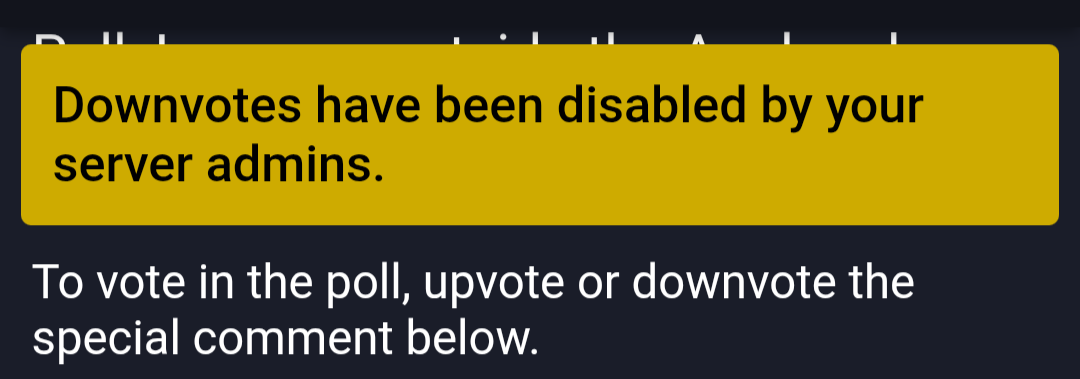
Beehaw is the same way. I’m fine with not having downvotes, I generally don’t tend to miss it…
English language, local keyboard and formatting
Here are the reasons why I use all of my electronic devices in English:
- I already know English, so it’s not a burden.
- Localization is never perfect. Just dig a bit deeper into the settings in Windows, and you’ll always stumble upon some English here and there, no matter what the language setting says.
- Troubleshooting sucks if you have to use another language. There are a million posts, answers and articles about your problem written in English, but only 9 written in your local language. Among the million articles in English, you’ll also find a few that were written by people who know what they’re doing. The 9 articles and posts in the local language were all written by clueless idiots.
- With some applications, like Excel, localization really hurts usability. I guess it’s fine for people who make calculations only a few times a year, but people who use Excel on a daily basis just hate the translated function names. If you already know your way around the English functions, using a translated version means you’ve got your both hands tied behind your back. What used to be trivial, suddenly becomes an epic voyage, just like it is with those who use Excel only once a year. Good luck trying to get anything done with the translated version. It might even be be faster with a pen and paper.
Excel translating function names surely has to be among the most pathetic decisions of software history
When you see someone using it in another language, you can immediately tell that they aren’t doing anything serious.
Dunno, isn’t logo older, with the whole frigging language translated?
Holy fuck, I despise translated Excel with passion. That’s a crime against humanity and the dumbest thing Microsoft ever did - and that’s a stratosphere-level high bar already.
I kinda get it where MS is coming from with this decision, but I don’t approve of it at all. They want to be more user friendly with all audiences, so that they can sell excel to small farmers in France, who definitely don’t speak a word of English. I guess that attitude should tell you that doing serious calculations wasn’t the main goal here, even though nearly everyone is using Excel that way.
This application is a victim of its widespread success. People make some pretty intense things with it that definitely call for switching to Python, R, C#, fortran or whatever. Because of that, serious professionals can’t avoid it any more. They can’t just treat it as a fun little toy it really is.
Is it really a toy if it’s turing complete?
As long as you’re doing simple little things, it’s fine. Try to do serious stuff with it, and you’ll end up fighting against the program at every turn. Professional grade software aims to make your life easier, not harder.
deleted by creator
It also sucks to use excel with tutorials amd you need to translate them on the fly.
Translating the UI is annoying, but trying to translate the function names is just pure agony.
English, every tech device is in English. Mostly because out of habit. I grew up using tech before proper translations into my native language started to appear and now it’s just really odd to see tech in my native language.
In addition, troubleshooting is easier. Most troubleshooting guides are in English and translating it into my native language can sometimes have odd translations. So it’s easier to just skip that extra layer.
Yeah all of the software terms like ‘wizard’ ‘manager’ or ‘shortcut’ have super weird sounding translations in my language
In addition to everything said, people underestimate how god awful some translations still are. Stuff like date pickers where May is translated as “maybe” or “three days left” where “left” is translated as “opposite of right”. Even for websites I’ll prefer the original language even if I don’t exactly speak it, and then translate myself the part I need.
If you see bad translations in open-source projects, please help by fixing them :)
It’s a straightforward way to contribute to open-source, even if you know nothing about coding, and it helps a lot. It’s hard for open source projects to find good translators.
The other thing that really helps is improving documentation. Developers hate writing docs :)
I remember seeing dates displayed in the wrong case. It felt like reading “June 15th of the mondays”. (and it would translate back to something pretty close to that)
Reading through this thread really makes me wish Esperanto or some other auxiliary language caught on
Isnt that english?
Esperanto is a romance-adjacent language using the Roman alphabet. It has its own grammar and phonetics, with rules that are flexible enough that a word-for-word translation from English or German will have a fairly correct sentence structure. As someone who speaks English, knows a little French, and has heard German, I expect it is closer to Spanish or Portuguese than English, but it isn’t just like those, either.
If you mean “is Esperanto English”, the answer is no, they’re pretty different, Esperanto combines elements of latin and slavic languages. If you mean “Isn’t English already an auxiliary language”, the answer is also no. English is a lingua franca, not an auxiliary language.
Fascinating, I didn’t know about auxiliary languages
I like Interlingua.
TBH I don’t know much about other auxlangs/conlangs besides Esperanto. What makes you prefer Interlingua?
I prefer Interlingua because it is comprehensible right from the start if you speak a Romance language and I imagine it is sufficiently comprehensible for an English speaker. There’s this saying that it is “a language you already know but have never learned”. This is done through more natural semantics and syntax.
About this following part, I’m not sure, but I’ve heard they also call it “the modern Latin”. As I understand it, in order to be decipherable to all Romance languages speakers, it employs old Latin roots (with variations). The cool part, in case this is correct, is that we all know some of these words via science, arts, philosophy… (aqua, caelum, ovum…).
Looking at examples online, it is surprisingly easy to understand! I can see it being better than Esperanto for romance language speakers specifically, but it still seems to me like Esperanto would be a better auxiliary language due to the simpler grammar rules and no fixed word order
This kinda reminds me of Interslavic. It’s the same thing, but for slavic languages. As a speaker of one, I truly do understand interslavic without having ever learnt it. I think these things oight to be used more internationally, although I guess English will always rightly have the crown of the lingua franca
I have mine set to English because it’s shit from ass to troubleshoot anything computer related in my native language.
Yeah. Also I never learnt all the unnatural sounding translations for software terminology like ‘… manager’ ‘wizard’ ‘shortcut’ etc. so it would just be really confusing to me (the word for ‘shortcut’ in my language literally translates to ‘representative’)
I used to translate things in Debian, but I stopped for this reason. It’s making it harder for everyone. People in sweden don’t know the swedish technical word for “routing”, but everyone knows what a router is. (Trivia, the word is “dirigering”.)
Well that’s just the sound a bicycle bell makes, no wonder nobody takes it seriously
When I started computering, there where no localised systems. When they started translating, the German was often misleading, incomplete, or just didn’t fit in the button or whatever. So I stuck with English. Somewhere along the line I switched to en_UK, though.
And yeah, in this day and age I have no clue how good the translations are, because I never checked them.
or just didn’t fit in the button
Most German problem ever lmao. I just noticed you have Pos1 for Home, which makes sense ig, I was just never expecting a numeral on a key that isn’t a number key
The end key becomes ende. Over 30% increase!
Same here. My native language is Spanish, and the localized terms always felt weird to me.
I also always use English keyboard layout, regardless of what is printed on the keys.
The only thing I change is date format, because US date format hurts my brain.
I do use German key layout, as I’m used to that for decades.
And German number, currency, date, address formats, as the English are just whack
What about the ‘ñ’?
I have a second keyboard layout configured, and I switch to it for the ‘ñ’ and the tildes when needed.
In Czech we have a ‘prpgrammers’ variant of they keyboard layout, that is in fact the US layout but types the diacritics if you type ctrl+alt+key. Spanish might have a coders variant too
Interesting! I’ll look into that, thanks!
My GNU/Linux computer has been set to Basque language for three decades. It works good.
English. Except my phone because of how it handles keyboards
I prefer english UI everywhere, and then my danish keyboard layout ive used since forever
Do you use qwerty or qwertz? I force qwerty on all of my keyboards
Qwerty
But scandinavian layout
Just finished setting up a Debian computer with a really strange mix of localisation settings. Keyboard layout and number formats are local, but the UI is in English.
Don’t know what your mobile OS is, I set my Android to English and use HeliBoard for the keyboard app. It even remembers what app should get Swedish, German, English layout and word suggestions.
I’m Dutch and always set everything to English. Except if Dutch or German is the original language of the content.
I really hate software that is German native and was somehow translated to English by someone who has the English skills of a 5th grader…
Generally same here, shame phone apps are not language selectable in most cases.
English, with custom key bindings for accents etc. Mostly because I hate AZERTY with a passion.
I use Dutch, because I’m one of the three Dutchmen that actually likes his language and I don’t want to see English all day.
Neither
Troubleshooting is done with
LANGUAGE=EN.When I started using computers, my mother tongue had spotty support. Most of the content that I need(ed) to digest is also in English.
Only on past few years it made sense not to use English but now I’m habituated
Smartphone: No
PC: No
Programs: DependsEdit:
Forgot, my debian servers are configured for english with german keyboard layout qwertz.