You must log in or # to comment.
It’s funny how he (a university professor from uk) is very probably part of that 10%, but writes as if implied he’s not lol. The people in rich countries has really no notion of how rich they are when compared with the rest of the world.
Also, I see that a lot of people around here seem to identify themselves in the top 10%. maybe that explains how I (low-income person from the third world) feel so detached from the community, especially in topics related to tech, as if we lived in different worlds. Well, maybe I really live in a different world than most around…
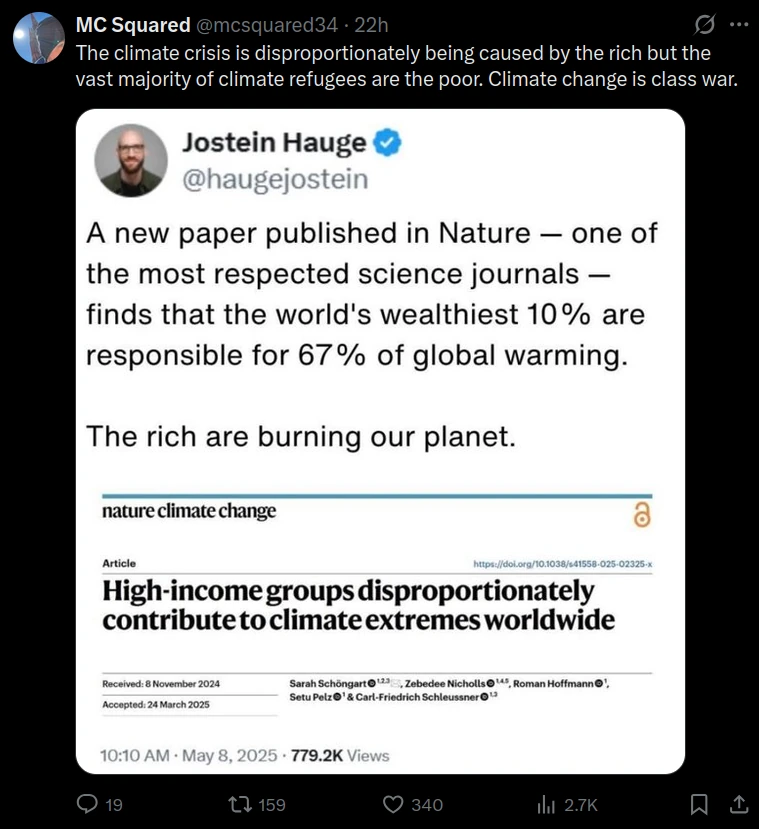
So we should do something about it
This is why I support carbon taxes
67
10%, chances are very good that you’re it.
Not that it matters much, postfossil indefinitely sustainable planetary population is a lot less than one billion, perhaps as low as 100 million. It would be just 500000 if we were a just another species our size.
This. And it’s 10% by income and not 10% by wealth. If you are even in the 2% of income ($180k/y), you’re basically a wageslave with a chance not to retire in time
In 1800 the global population was a bit over 1billion.
Yes, we haven’t been longterm sustainable even since preindustrial times. Worse, the carrying capacity after all is sung and done will be a lot lower than the preindustrial one.
No, I don’t have a pre-tax income above $70k USD. Do you?
I do, or close enough.
Did you read my second paragraph, about the postfossil planetary ecosystem carrying capacity? And no, without fossil fuels you can’t build and maintain renewable or nuclear energy infrastracture, either.
Btw there’s a good chance that you’re in that 10%
https://wir2026.wid.world/insight/global-economic-inequity/ (Figure 1.4)
To belong to the top 10%, an individual must earn about $65,500 per year (around $5,460 per month). To reach the top 1%, the threshold rises to about $250,300 annually ($21,860 per month). Unsurprisingly, most of the population earning at these levels is concentrated in Europe, North America, and Oceania.
That’s not high income groups, though. It’s not high income to make 65k in America. No way are you burning more than rich anyone else in any even developing country.
You don’t think someone making 65k living with a smart phone, car, AC, electric heat, using goods like toilet paper, hot water, plastic, crafted metals, etc. produces more pollution than someone in the 90th percentile wealth in a developing country?
This.
The way to know where you are in the pollution impact is if you drive a car you’re in the top 10%. If you regularly fly you’re in the 1%, and if you fly a private jet you’re in 0.1%
Why rich people use so much more energy: It’s mainly all the traveling, says a comprehensive new study. https://www.vox.com/energy-and-environment/2020/3/20/21184814/climate-change-energy-income-inequality
I’ve reduced my meat consumption (and heavily reduced my beef/dairy consumption) partially motivated out of climate responsibility, switched to an EV (and still drive about half of the national average distance per year, with only one car shared in my 4-person household).
But I fly a lot, and no matter how you slice it, I still cause way more carbon emissions than the national average. A round trip flight between New York and Los Angeles on economy class commercial aircraft emits about 600 kg of carbon dioxide per passenger, or 0.6 tonnes. With the world average emissions of 4.7 tonnes per person, a person who flies from one side of the country to the other (or between countries) quickly adds up to more than their fair share.
Yep. Flying is the most polluting thing the typical citizen of the wealthy world has access too.
It is not as bad as the ultra rich taking their 200 foot yacht to helicopter ski down the melting glaciers of the antarctic, but a single long flight exceeds the annual per capita emissions for a large chunk of the world.
There are 1.4 billion passenger vehicles in the world. So I don’t think driving is necessarily the 10% cut off.
there’s about 8.3 billion people in the world right now, so driving a car is something about 16% of the world does. Though that assumes most people have one car per person, and suspect that may not be true. The wealthier people have several cars per person, which lowers what fraction of the world drives. Though I couldn’t find any statistics on how many people regularly drive in the world.
For what it’s worth for the “average american household” transportation is usually their largest source of emissions. https://coolclimate.berkeley.edu/calculator
Nothing econ good can’t solve. For. The. Better.
10% of income is basically $70k/y. If you’re above this line - you are the problem
It is more complex then that. For example somebody earning over $70k/y might easily live car free and vegan in Paris, while not flying on vacation. Part of that is individual choice like living vegan and other parts are part of the system around that person, like the amazing public transit in Paris or that the French electricity grid is nearly emissions free. Somebody like that might well have carbon footprint below the global average.
In the end it is a systems problem. A well designed system should not allow people to harm others on a scale like that. But individuals do have agency and those with $70k/y more then most. If those individuals make good choices, then they might well be part of the solution and not the problem.
Yes and no. It is possible for someone earning 70k/year to emit below the average (let’s also keep in mind that the goal is not to be below the average, but to be at 0 emissions/impact), but everything you can buy has a CO2/environment-cost related to it.
As soon as you spend more, you have a higher impact. Of course there are more and less impactful ways of consumption, so you do raise a good point, but we’re not going to consume our way out of this misery.
A really nice book I shove down the throat of every single one of my friends who’s not running away fast enough is The Day the World Stops Shopping, in case you have way too much time at hand ^^
Also 70K net or gross is quite a big difference.
Also me not having kids and commuting using an EV that’s charged at almost entirely by solar/nuclear means I am well below that threshold.
Where I live district heating also comes from geothermal heat.
It’s before taxes.
Yay! I’m not part of it!
Granted plenty of people who earn less than me have far worse impacts on climate and some people who make more may be doing better. Like someone in NYC making much more than me might be causing less emissions just because better public transit and all their money just goes into rent. Meanwhile, someone in Texas who eats beef regularly, drives 20+ miles in their truck most days, etc could easily be worse while making significantly less.
And they won’t stop until we stop them.
🌎🧑🚀🔫🧑🚀
So burn the rich.
It’s a compelling argument but I’d find it even more compelling if historical countries like USSR and China where the working class “won” had better environmental records than they do.
Per capita, especially cumulatively, their emissions are extremely low.
btw 10% of 8 billion is 800 million people, so it’s basically “the west”.
Yes.
I was referring to the past. Chernobyl, Baku, Aral Sea, Norilsk, Liaoning, etc all of which were very messy places while being run in a command economy.
This is pretty nuanced, but I do feel like if you look at the environmental damage by the west on colonised nations and add all of that up, you’d probably still have way “more”, the only question is how you compare different kinds of environmental damage.
Just because capitalism runs in circles socialsm doesn’t have to, too.
Yep. I’m sure we’ve all learned a lot since then.
We know that socialism has in the past made the same trade-off between the environment the economic growth. That the environmental damage wasn’t even worse might have more to do with how bad they were at growing their economy than anything else. I don’t know, I wasn’t there.
It’s going to take more than eating the rich. Workers will need to be continually on their guard against the centralization of power and the emergence of a disconnected elite that happened every other time socialism was tried (and every time capitalism was tried, to be fair).