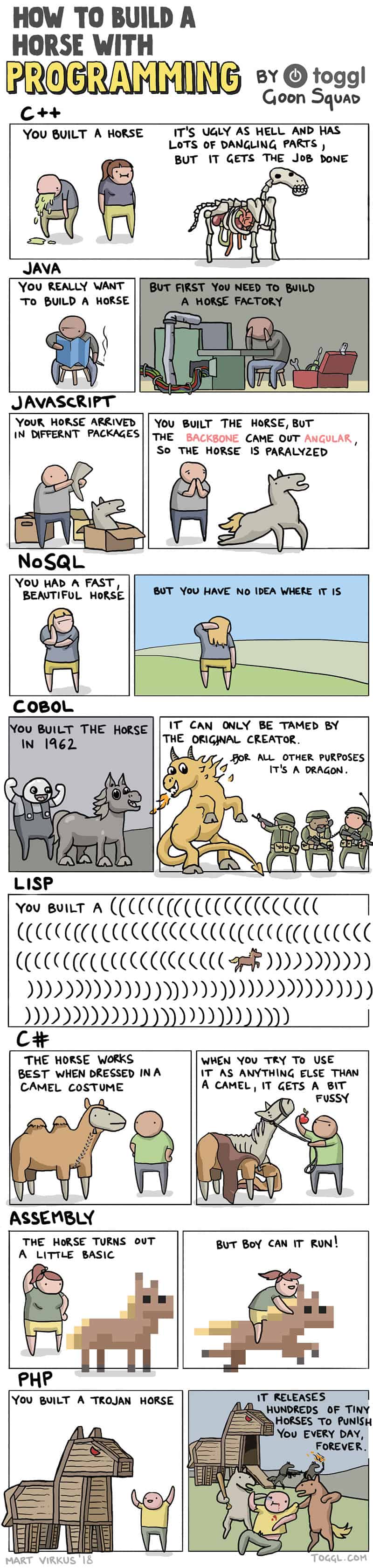
When I first saw this comic I was a relatively new COBOL programmer. It felt accurate.
I am now my employer’s senior COBOL dev. It still feels accurate.
Needs a python horse in there.
Probably something about “why build a horse when you can just
import horse from field?”horse()from field import horse*Well don’t I look like a grade-A moron now?
The LISP parentheses are not equally balanced. There are more ( than ).
Exactly 6 more.
)))))) There, the horse is contained now.
You thought so, but there was a teleporter
Shout-outs to enclose.horse!

This might be a client issue, eg: when images are too big, Thunder pixelate 'em


It is indeed, thank you!
Well, this is the original as it gets, direct from the source.
All right. Sorry if that came across the wrong way: I wasn’t actually trying to complain, I just used the meme because I noticed the low resolution. I don’t know if I’m getting too old for this crap, but back in the day, that meme used to pop up all the time as a response to low-resolution images. ^^
Nah, that’s ok. Though you have to click on the image for full resolution. On Lemmy it shows small for some reason.
Oh, didn’t realize that, thank you!
No problem!
On the boost app there’s a tiny HD button you can click that should sharpen things up a bit.
Thanks!
That’s a little reductive but but… sure.
Sounds like you have a future in network news 😉
As a non-programmer, TIL Java and JavaScript are two different languages.
Person1: I built a script in Java.
Person2: So Javascript?
Person 1: NO!
When JS was being developed, Java was all the rage and it merely was riding it’s coattails. At the time of its creation it was nothing like Java either.
But notice that lisp was the only one where you actually built a horse.
Also assembly. And the dangling parts.
This is no time for joking around…I just wanna know if I can turn my webserver back on yet?! Hello?!? Anyone?!
If you keep it off, it’s significantly harder to get hacked.
Until your hosting service gets pwned…
The Fixed Point Expression / Y Combinator expressed in horses:
    Y = (λ f. (λ x. f(xx))(λ x. f(xx)))
    ;; so then, give Y a horse argument with apple parameters:
    Y🐎️ = (λ f. (λ 🍎.  f(🍎🍎)) (λ 🍎. f(🍎🍎))) 🐎️   ;; [1]
        =       (λ 🍎. 🐎️(🍎🍎)) (λ 🍎. 🐎️(🍎🍎))      ;; [2]
        = 🐎️(   (λ 🍎. 🐎️(🍎🍎)) (λ 🍎. 🐎️(🍎🍎))   )  ;; [3]
        = 🐎️(Y🐎️)                                       ;; [4]
Explanation
- 1: x is 🍎, but could be anything. It’s just a function parameter nested within another.
- 2:
λfgets executed and vanishes from the left, substitutingfinternally with🐎️. This is now a new function, with left group as the function body, and right group as the function argument, despite being identical. - 3:
λ🍎gets executed and vanishes from the left, substituting🍎with(λ 🍎. 🐎️(🍎🍎)) - 4: Everything within the main brackets at [3] has been seen before at [1], but with f being 🐎. Thus we have bred a new horse. We can breed infinite horses this way
Rust builds a unicorn
ho-rs
Goddamnit I actually snorted really loud at that one!
Glad to be of service. :)
I just saw this message by the way, probably an intance sync issue.
I didn’t get any notifications for a few days, until half a day ago, so probably on my instance’s part, no worries
Ah I see. It seems there was a version update for Lemmy so could be on both sides as well.
It is perfect and will run for a million years.
Dodges all traps and jumps over all ditches whether you see them or not.
But you are already too old to ride it.
Ctrl-F “rust” - > 0 matches
I sense a pertubance in the force
Well duh, Ctrl f doesn’t work on pictures!
…yet. Then again, that’s literally what “alt” on images is for.
And here I am glad that I try to avoid phpMyAdmin too, whenever possible.
C: You build a horse. Well, it’s not really a horse, but it can do almost all the essential horse-things. It’s incredibly fast and compact. Your horse is named “Blue\0\0\0\0\0T~31wsXEi]DiMGW8mh^3”. Oh, and now someone else owns it.
Is it a dig against C# only being good when using it from F#, i.e. OCaml for .Net or am I overthinking this?
I don’t know. I thought it was a dig with certain C# dev products trying to mimic how other technologies behave, like WebForms.
In Horse64:
import horses from horses.horse64.org

func main {
    var my_horse = horses.Horse(color="brown")
}
And in Horse64 Root:
import horses from horses.horse64.org

func main -> bool {
    var my_horse <- horses.Horse
    my_horse.init("brown")
    if failed(my_horse.init) {
        return no
    }

    defer my_horse.destroy()

    my_horse.run()
    if failed(my_horse.run) {
        my_horse.stop()
        return no
    }

    my_horse.stop()
    if failed(my_horse.stop) {
        return no
    }

    my_horse.eat("hay")
    if failed(my_horse.eat) {
        return no
    }

    return yes
}