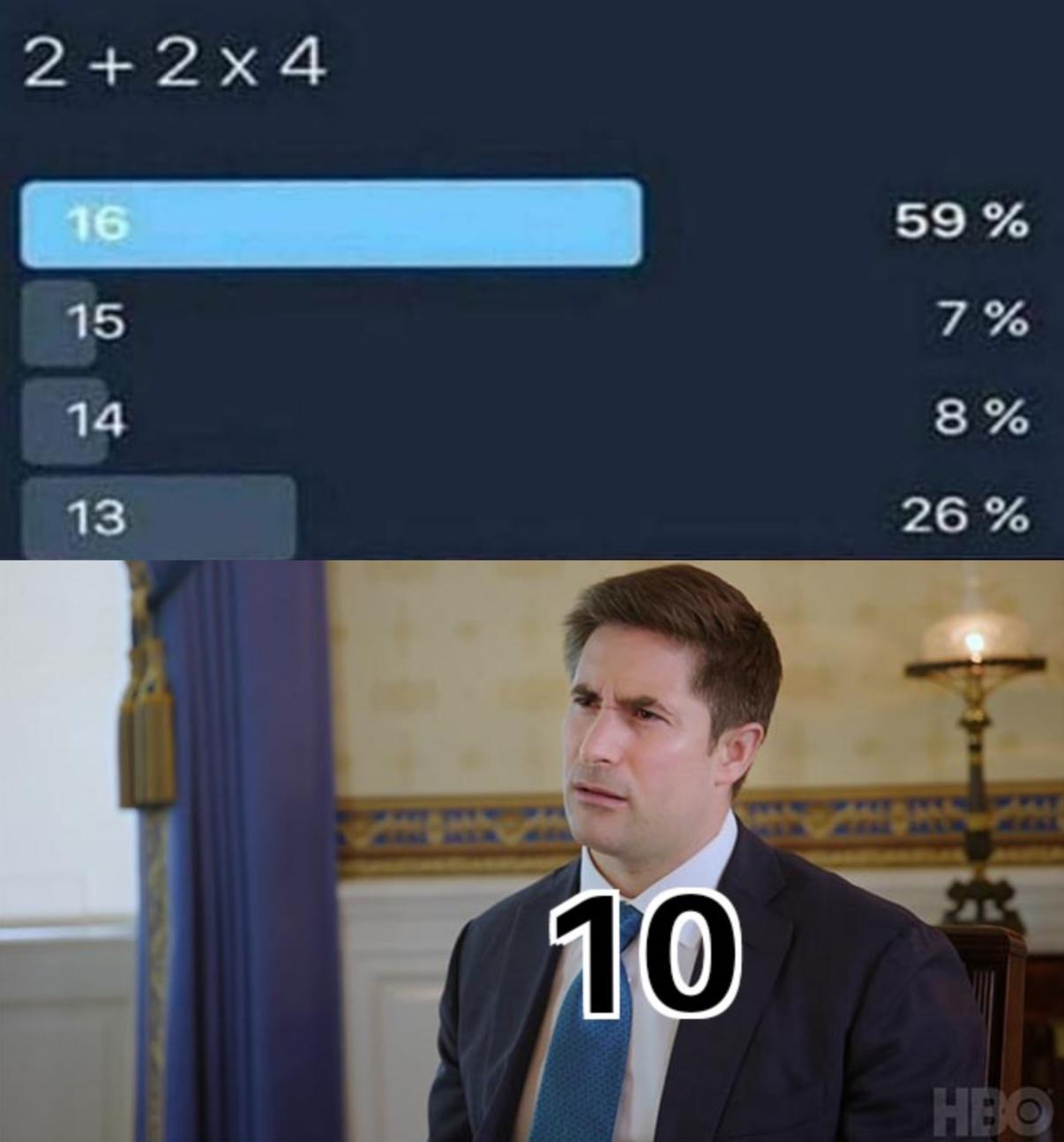
Since the correct mathematical answer isn’t one of the options, the people picking the other options are representing a real resistance to the order of mathematical logic that binds us.
The real answer is 14 because I’m 14 and this is deep.
13, because it’s just as wrong, but it’s the closest to 10. ;)
For me it’s 13 because it’s the “wrongest” one. Every single number in the term is even so you’d expect people to at least choose something that is even, too. Not only is 13 odd, it’s a friggin prime…
HEAR HEAR!
Sadly, this is actually true, people actually don’t know simple math and operation order.
And they ask me why I hold such low expectations for the future 🤦.
To be fair, it’s completely arbitrary, and all of math would be easier to understand, although slightly more verbose, if the only rule of order of operations is “always use parentheses to denote order, there are no implied parentheses”.
lazy mfs from centuries ago who were mortified by the thought of having to write
(and)too much (lord what i wouldn’t give to hop in a time machine and show them lisp) should not be dictating our mathematical notation in this century. Explicit grouping is always more obvious to the reader.Maybe for very simple calculations like this one, but for more complex ones parenthesis actually make them much harder to read and write. If you’ve ever built a complex functions in Excel you know how difficult it gets because for 90% of the excel operations require parenthesis which means it works exactly like you’d want math to work. Just yesterday I had to do a more complex index match search in excel and excel corrected my parenthesis, because when your function is supposed to end with 5 parenthesis good luck keeping track of how many parenthesis you actually need to write out. Similarly if a week later I would have to change something inside that same function it’s going to take a lot more time to deconstruct the formula because of the abundance of parenthesis.
And the addition of parenthesis in math is entirely unnecessary because the nature of most operators already dictates the order of operations. Exponents are just multiplications and multiplication are just additions. 23 is the same as 2 x 2 x 2 is the same 2 + 2 + 2 + 2. If you take the example in the image then 2 + 2x4 transposed into additions is 2 + (2 + 2 + 2 + 2), parenthesis added to indicate what used to be the multiplication. Why people get it wrong is because they don’t understand the nature of those operators and so they do (2+2)x4 which is how they get (2+2)+(2+2)+(2+2)+(2+2) = 16. The order is clear, you can’t do addition before you do multiplication, because multiplication is a certain form of addition, and you can’t do multiplication before you do exponents, because exponents are a certain form of multiplication. The inverse functions maintain the same order of the function they’re inverting, meaning you can do subtraction before division and you can’t do division before rooting. No need for parenthesis for the natural order of operations. Parenthesis serve a purpose when you need to denote exceptions to the natural order of operations, like (2+2) x 4.
It’s not a “natural” order of operations. Why in the world would you think that we more often add before multiplying instead of vice versa? That’s such a weird claim
Did you just read the last sentence and not the rest of the comment? I went pretty in depth about what I mean by it. I don’t think we more often add before multiply, I know we must solve multiplication before doing addition and vice versa is the wrong way to do it, unless there’s something else, like parenthesis, stating a different order of operations.
Multiplication is a notation which means add some number by itself a number of times.
5 x 3 = 5 +5 + 5
2 * 4 = 2 + 2 + 2 +2
So when you see some like 2 + 4 * 2 it literally means. 2+4+4
By that logic it could just as well be 2 + 4 * 2 = (2 + 4) + (2 + 4) = 12. You still need to know to multiply first, or it’s arbitrary
Edit: a lot of you are missing my point. The expression above is wrong, duh, but my point is that the choice to “expand out” the multiplication first is a convention that the mathematics community agreed on, not a fact that can be proven or measured. That’s why it’s arbitrary. @kogasa put nicely, PEMDAS is just a notation, it’s how we agreed to read and write our math, but the underlying math is no different. If we all agreed to scramble the order of operations, say to add before we multiply, expressions will look different, parentheses may need to be added or removed, but they will still be mathematically consistent if we are consistent in writing and reading in that agreed upon order of operations.
No you expand it all out first.
I know that my example is wrong, I’m trying to make a point
In your example you lose distributivity. (2+4)2 is 22+4*2, which doesn’t matter for numbers but it matters for algebra. If addition comes first then there’s no way to represent distribution.
The distributive law, assuming commutativity and other axioms, is a*(b+c) = (a*b) + (a*c). Notice how it does not matter in which order you evaluate + and * in this expression due to my use of parentheses.
PEMDAS is notation. It has no influence on the actual underlying math, only how we write it.
You’re absolutely right, not sure what I was thinking.
PEMDAS is notation. It has no influence on the actual underlying math, only how we write it.
Thanks, I’ve been trying to figure out how to put this and you did it concisely!
It’s not logic, it’s that what it means. 2*4 literally means 2+2+2+2. Just like 8/2 means how many times you can add 2 to itself until you get 8.
That’s what it means.
So why use braces? Because in more advanced maths you have more complex expressions that can’t be express in just multiplication which often occur in algebra or beyond.
For example what does 2 * ( a + 3) actually mean? Like why do we need to do the addition first. Its because we don’t know how many times we need to repeat the addition until we know what a means.
Let’s say a are points on an axis, and at some point it is worth three the. At that moment that expression is 2 * (3 +3) = 2 * 6 which is equal to 2+2+2+2+2
But in the next moment a might be 1
Right?
What’s arbitrary are the labels on the rules. The rules themselves aren’t arbitrary.
See my edit, I think you misunderstand me
“expand out” the multiplication first is a convention that the mathematics community agreed on, not a fact that can be proven
That’s true, but it’s not that hard either.
It’s also not that hard to just write it in a far less confusing way in many cases.
In this simple case,
4 x 2 + 2or2 x 4 + 2would have been superior choices because both people reading left to right and people following pemdas correctly would get it right, and only people mis-remembering pemdas would be confused.Even then it’s still a quick mistake to make. If I’m not paying attention I could easily make a mistake like this, because I’m used to reading things left to right.
I would love to watch people who say that diagram a sentence, per 10th grade English class rules.
(For the record, PEMDAS).
Is PEMDAS anything like PEBKAC?
To be clear, it’s the standard order of operations (PEMDAS) that is arbitrary. The expression in the post, assuming PEMDAS, is not arbitrary. There’s only one correct answer.
Also, I dunno man. The window from where math is complicated enough to have multiple different operators to where expressions get too complicated to be easily readable with just parentheses to denote order should be passed by like, early to mid highschool, if not junior high. Point being, frankly if you’re struggling with PEMDAS, your either still a high schooler, or you probably should be.
Or we can all learn polish notation
By the end of highschool you’ve mostly stop dealing with numbers and moved on to algebra, which foregoes the confusion of PEMDAS. a+bc is very obvious.
I will literally commit hate crimes against all of humanity if I had to write brackets around all operations in math. Surely remembering 6 things is easier than writing out brackets 100 times a day
Polish notation ftw. + 2 * 2 4, no parentheses needed and no ambiguity. (Though makes it harder to see at first glance where is the cut between the to terms of the operation.)
wow, that’s an interesting but weird notation from my perspective
Bold of you to assume people would get how parentheses work. Especially when multiplying blocks of additive parentheses (unless you’d expect to always write the expanded form, please tell me you wouldn’t)
always use parentheses to denote order, there are no implied parentheses
I completely agree on this, and yes, this is what I always do, cuz… well, we’re human, we make mistakes, parentheses makes things easily visible, thus cutting down on mistakes.
Still, I do know operation order, as a rule I mean. In simple calcs like these, making a mistake is almost impossible. Thus, people that answered 16 probably just don’t know the order… that is something you learn in 1st, 2nd grade, it’s not quantum mechanics we’re talking about here.
lazy mfs from centuries ago who were mortified by the thought of having to write
(and)too much (lord what i wouldn’t give to hop in a time machine and show them lisp) should not be dictating our mathematical notation in this century.We only do that cuz we’re not sure how the compiler will interpret the operation order, and there’s waaaay too many versions and different languages to actually remember how each of them interprets math operation order. So, we do a safe bet, put parentheses on everything. Hell, I do it as well, I just can’t be bothered to remember if C interprets it like this, Python like that, Rust like… god knows what. They should, in theory, know math operation order, but let’s face it, we all do it cuz we’ve been faced with bugs that are a direct result of the compiler not intepreting things as it should.
That being said, yes, I do agree that prentheses on everything, even math on paper, is the way to go. Plus, even people that don’t know operation order, will learn it a lot qucker if you just show them how easy things become once you start using prentheses.
deleted by creator
You learn these things in 1st, 2nd grade. This is not quantum mechanics, this is simple basic math.
US here, wasn’t taught until high school
I understand why people get 16. But how do they get 14, 15 and… 13??? Trolling, right?
13 is actually the best solution given that 10 isn’t an available option.
I wouldn’t call the “best” solution to a clearly wrong option, the same as I wouldn’t call the “best” option jumping off a cliff to an assured death instead burning alive on a fire, but yeah it’s the option closes to the real one.
Ohhh I see. Those 26%ers trying their best to approximate
I’m really bad at math (due to my severe dyscalculia), but I learned back in school that you should prioritize multiplication over addition. It means: First, you do 2x4 which gives you 8, then you add 2 to that, resulting in 10.
Therefore: 2x4=8+2=10
Please Excuse My Dear Aunt Sally, muthafuckahs!!
Ok, I get how applying all the rules of arithmetic wrong you could arrive to 16.
But how in the holy Pythagoras did someone decide that
2 + 2 * 4 = 13?BEDMAS says you do multiplication before addition, so it’s 10.
The one I learnt at the dawn of time was BODMAS.
bracket of Division Multiplication Addition Subtraction.
I learnt this in the 70’s early 80’s in South Africa, so not sure if things have changed.
B/P are the same (brackets/parentheses) and O/E are the same (order/exponent), and the order of M and D doesn’t matter since those two have equal priority and are evaluated left-to-right. Hence PEMDAS, BODMAS, BEDMAS, etc. are all the same.
Checked with my old basic calculator, the answer is indeed 16 😂
well, my modern advanced calculator told me it was 15 sooo
It’s clearly 47
He looks like he just walked straight out of Idiocracy
I’m not sure if you’re aware or not, but at the moment that photo was taken, he was in the middle of trying to interview then-president Trump.
I don’t remember what specific thing Trump said to elicit that reaction, and I’m not really in the mood to re-watch the interview to remind myself. Suffice it to say, Trump said a lot of just absolute nonsense.
Yeah I’m aware of the interview, but he also looks like the actor from Idiocracy and the expression he was making when he realized the time skip.
If they wanted the multiplication done first they should have put it first if they wanted it done separately they should have put it in brackets. Not my fault some maths guy invented a specific order to do sums in who the fuck cares oh my god we read left to right fucking hell
The fundamental way that math originated cares…
Except math isn’t real and was entirely made up. Including the order in which the operations are calculated.
Math isn’t real? The universe, and its laws of physics, disagree.
Math is our representation of real world phenomena. The universe is not calculating any computations when gravity takes effect. This is basic mathematical knowledge that they teach you when you first learn physics. So no, math is not real and is entirely made up.
The universe is not calculating any computations when gravity takes effect.
How do you know?
I see what you’re saying. But what if we tweak things a little:
Math is real, it is numbers that are invented, the discreet packets in a ruler, a measuring stick. Like an imaginary line in a grid, such as the tropics and equator.
Sure, but it was made up that way for a reason
I’m sure they had a reason. Doesn’t mean it wasn’t a completely arbitrary reason
(+ 2
   (* 4 2))
Go brrrrrr