

1·
7 days agoThat was kinda his point that it can be anything. In his case it was Neovim and grew a lot because of it.
So once the novelty wears off and it’s just the tool you happen to open, what then?
You move on to the next “playground”.
That was kinda his point that it can be anything. In his case it was Neovim and grew a lot because of it.
So once the novelty wears off and it’s just the tool you happen to open, what then?
You move on to the next “playground”.

Uruky is great.

… Would prevent people from finding It also so might as well not bother at all.

Interesting that you can both use a paper roll and a sheet. Pretty compact as well for a printer!

I buy from https://eu.dilling.com/, Danish company, makes clothes I think in Lithuania (not sure if all of them).

Your link doesnt work, xcancel got suspended.
I used duckduckgo at first now pay for mozilla relay.
Can’t remember exactly why I switched. I think I didn’t like it that I couldn’t see the emails I had generated. Also you needed the extension for something and I found it annoying. In general I feel like I have more control in Mozilla relay than I had in DDG.
As for the price it’s 1 eur / month. I treat it as a donation to mozilla and don’t sweat it, considering I use firefox on phone / desktop they deserve it.

“Democracy basically means: Government by the people, of the people, for the people… but the people are retarded.” ― Osho

For me it’s always my left arm’s fingers that get tired first, especially the pinky and the ones close to it.
I have now resorted to using the right shift and rebinded my right alt to act as the control key on top of using it as a special modifier key for certain actions.
While holding Right-Alt:
h j k l = arrows,

w b = word-jump (Ctrl-arrow),

0 4 = Home / End,

u d = PgUp / PgDn,

; =  esc

x =  Delete

Shift-x = Ctrl-Delete,

Backspace = Ctrl-Backspace,

Enter = left-click.

All the other keys act as if I click Ctrl. Like RAlt +y = Ctrl + y...
There’s also one more key near the Right-Alt that I don’t know what it’s called, but I rebinded it to be Ctrl + Shift. All of my terminals navigation commands are Ctrl + Shift.
In neovim I even binded Space +w to click Ctrl +w cuz Right-Alt + w is word jump. And I use window navigation really often.
I also have caps-lock binded to esc but don’t use it that much. 3 ways to press esc for me (4 in neovim cuz I have jj = esc). 😅
This has helped me tremendously.
What makes you say that?
The new textobjects al and il are a great addition as well. Won’t need a shortcut to select the whole buffer anymore and won’t need to do 0 -> ^ -> y$
:D well… you can always use a distribution like lazyvim and chill
the endorsement was on their website
the change that got merged was the one that replaced that endorsement with another one
Vaxry, the developer behind the Hyprland Wayland compositor (another Omacom-funded project), was banned in 2024 by Freedesktop.org’s Code of Conduct team over a pattern of the Hyprland Discord enabling harassment of trans community members, including an incident where moderators changed a trans user’s display name to strip their pronouns. Vaxry’s own public response framed the ban as ideological overreach by “social justice warriors,” while the Freedesktop side, recounted at LibreNews, describes over a year of private attempts to get him to address the toxicity before going public. Hyprland’s contributing guidelines now ban “political” speech too.
I’d recommend anyone actually accusing him of anything first read https://blog.vaxry.net/articles/2023-hyprlandsCommunity . IMO it’s very overblown and weakens similar accusations.

I think it’s helpful to separate the problems of the technology itself from all the BS that big tech companies engage in when developing and pushing it.
Say you only use small, open-weight models that are hosted locally in a data center that is conscientious, environmentally clean, has strict data privacy policies and doesn’t pull the bullshit big-tech do.
You use them minimally and responsibly, you don’t over-rely on them. Is there a problem in that case?
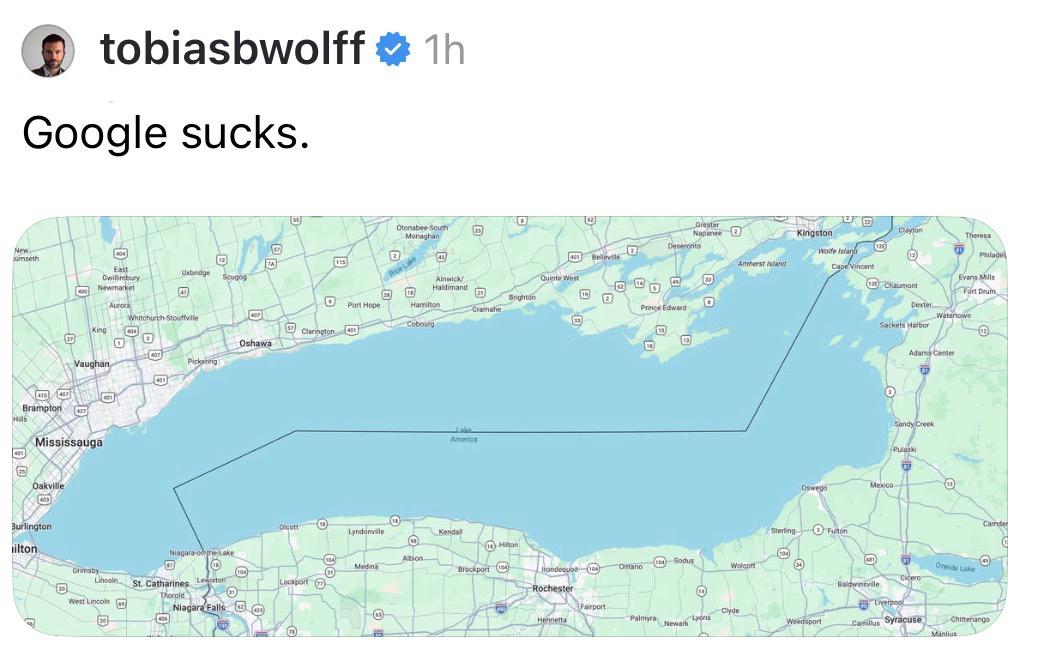
https://www.404media.co/google-maps-lake-america-lake-ontario-name-change/ more about this for those that live under a rock
It was unclear in the days immediately following the order whether Google would respect the name change. MapQuest, the 1996 navigation service that still exists but most people stopped using in the early 2000s as Google Maps took over, went viral last week after posting a screenshot of Lake Ontario on X, saying “We’re not changing it.” MapQuest also launched a “Rename Lake Ontario” web toy.
based
Google follows the U.S. Geographic Names Information System (GNIS), which formally changed the name for ‘Lake Ontario’ to ‘Lake America’ in the United States, according to Google’s announcement about the change, posted Saturday: “Since we update Google Maps to reflect name changes in official government sources, which is GNIS for the U.S., people using Maps in the U.S. will see ‘Lake America,’ those in Canada will continue to see ‘Lake Ontario,’ and those outside of the U.S. and Canada will see both names. These updates follow our long-standing policy for bodies of water with names that vary from country to country, and are starting to roll out now.”
https://github.com/neovim/neovim.github.io/pull/504/files “Full-screen Neovim looks cool as hell!”
Graphene said other phones don’t meet their security requirements.







I’m Lithuanian. It’s pretty strict here with guns, really can’t compare it with USA and not really sure why you mentioned it.