Also I’m learning French and everything has a gender but I don’t see any pattern to it at all. Pizza is female, books are male, a suitcase is female, hats are male and so on.
Also in French, the names of numbers go absolutely mental once you go above about 50. That’s got nothing to do with gender but I want to complain it whenever I can.
Mädchen is a diminutive, and all diminutives are grammatically neutral.
It’s the same in Dutch btw, and my girlfriend who is learning Dutch is frequently abusing this as a cheat code: whenever she doesn’t know the gender of a word, she’ll just use the diminutive and it will automatically be neutral.
Correct, all diminutives are neuter in German. In this instance the base word is die Magd (historically the maiden, nowadays the maid), which is grammatically female.
Ah, yes the famous quatre-vingt-dix-neuf (commonly pronounced “quatre-vingt-deez-nuts”). Numbers are quite a mouthful in French. One of the reasons I erased it from my memory the moment I didn’t need it no more.
So french is just like portuguese, but in portuguese you normally know if something is male or female by the ending of the words (with a feel exceptions), for example pizza is female because ends with “a”
This always confused me, even as a native speaker so I looked it up some. Ultimately it’s because modern German is the confluence of multiple older, historic languages one of which came from a tree with a strict male/female rule for nouns while the other one’s grammar defaulted to a neutral case.
As languages merge or adopt from others they often becomes a conjoined mess of multiple rules coexisting at the same time. A contemporary example is that in English the plural of a word is usually formed by attaching the suffix “s” to the singular form, aka house becomes houses. However there’s plenty of exceptions (mouse, mice) in particular if the words stem from a different language (octopus, octopi but nowadays octotuses is also acceptable). In that sense to people not privy to the etymology of words and who only study/learn the language per se there would be no perfectly accurate mechanism to predict the plural of a word.
That’s a misrepresentation of old English. Man used to be neutral, and was modified by were and wif respectively for man and woman. Wife comes from woman, not the other way around.


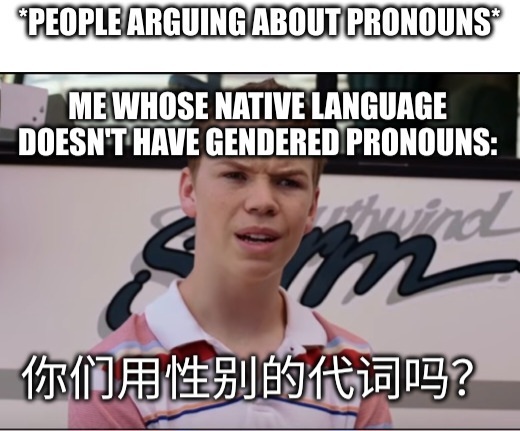
In German:
Man = male (der Mann)
Woman = female (die Frau)
Boy = male (der Junge)
Girl = neutral (das Mädchen)
No idea why lol.
Also I’m learning French and everything has a gender but I don’t see any pattern to it at all. Pizza is female, books are male, a suitcase is female, hats are male and so on.
Also in French, the names of numbers go absolutely mental once you go above about 50. That’s got nothing to do with gender but I want to complain it whenever I can.
Mädchen is a diminutive, and all diminutives are grammatically neutral.
It’s the same in Dutch btw, and my girlfriend who is learning Dutch is frequently abusing this as a cheat code: whenever she doesn’t know the gender of a word, she’ll just use the diminutive and it will automatically be neutral.
I just might have just learned smth about my native language.
I think it’s das Mädchen because it’s a sort of diminutive (by use of chen). But it’s been a while since I studied German.
Correct, all diminutives are neuter in German. In this instance the base word is die Magd (historically the maiden, nowadays the maid), which is grammatically female.
In contrast to Mädchen the equivalent for Junge, „Jüngchen“, has not entered officialese and is seldomly used in colloquial language.
And it is also „das Jüngchen“.
Austrians: da buah
Afaik it comes from Magd, which is female lol.
related to maid, mädel. confer “maiden” in English
Aber was machen Sachen :o
Ah, yes the famous quatre-vingt-dix-neuf (commonly pronounced “quatre-vingt-deez-nuts”). Numbers are quite a mouthful in French. One of the reasons I erased it from my memory the moment I didn’t need it no more.
So french is just like portuguese, but in portuguese you normally know if something is male or female by the ending of the words (with a feel exceptions), for example pizza is female because ends with “a”
This is the same in french, the gender of words is generally determined by their ending. (Which is not pronounced.)
Good to know, french is on my list of languages that i wanna learn someday
This always confused me, even as a native speaker so I looked it up some. Ultimately it’s because modern German is the confluence of multiple older, historic languages one of which came from a tree with a strict male/female rule for nouns while the other one’s grammar defaulted to a neutral case.
As languages merge or adopt from others they often becomes a conjoined mess of multiple rules coexisting at the same time. A contemporary example is that in English the plural of a word is usually formed by attaching the suffix “s” to the singular form, aka house becomes houses. However there’s plenty of exceptions (mouse, mice) in particular if the words stem from a different language (octopus, octopi but nowadays octotuses is also acceptable). In that sense to people not privy to the etymology of words and who only study/learn the language per se there would be no perfectly accurate mechanism to predict the plural of a word.
Also bonus content:
singular: “das Mädchen” (neutral) - the girl
plural: “die Mädchen” (female) - the girls
So in the plural form you have to use a female article again, but the actual spelling of the word is unchanged. Go figure 🤷♂️ 🇩🇪.
The simple past of read is read, but you pronounce it like red. I assume ever language on earth has its quirks.
“Die” is always the plural article:
DAS Auto - DIE Autos / DER Baum - DIE Bäume / DIE Fliege - DIE Fliegen /
In plural every gender has the article “die”
Well at least it consistently unlogical. But wait: it actually depends on the grammatical case for example:
die Mädchen = the girls das Haus der Mädchen = the house of the girls // the girls’ house
So depending on context male, female, neutral articles are all used (der Mädchen, die Mädchen, das Mädchen) 🤷♂️
That’s not a male article, that’s the genitive plural article
It was to make the male seem more important. Even in English the word “woman” comes from “wife man”. Everything was about the pecking order in history. Gender bias was a major part of that.
That’s a misrepresentation of old English. Man used to be neutral, and was modified by were and wif respectively for man and woman. Wife comes from woman, not the other way around.
Ohh oui, french numbers I think they go mental after 69 ( ͡° ͜ʖ ͡°)
70: 60+10 (soixante-dix)
91: 4x20+11 (quatre-vingt-onze)
Why? No clue I am not french.
May or may not have some relation, but next to France/part of, lies the Basque country, where all numbers under 100 are base 20+10, except 11 and 19…
57: 2×20+10+7 (berr-ogei-ta-hama-zazpi)
79: 3×20+19 (hiru-r-ogei-ta-hemeretzi)
French (in Belgium, Switzerland, and former colonies) also allows simple base 10:
70: 70 (septante)
91: 90+1 (nonante-et-un)
…so the geographic location seems to have an impact.
And just next to it, in Spain, everything is base 10… except 11 to 15 change the order from n×10+m, into 1+10 to 5+10.
Italian does the same, except it’s 11 to 16… just like in French.
English has a hiccup with eleven and twelve, then goes to n-teen, before going base 10 with n×10+m above 20.
German does the same, except it goes to m+n×10 above 20.
Overall, 20 seems to be a magic number, France just seems to have mixed in different ways of using it.
https://en.m.wikipedia.org/wiki/Vigesimal
Mädchen is neuter because it is diminuitive.
Das Häuschen Das Bäumchen Das Hügelchen
and so on. Diminuitive is always neuter, and Mädchen is diminuitive of Magd (or Maid, I forgot).
Reminds me of a famous quote from Danish humorist Jacob Haugaard:
I’ll just leave this one for you :)
https://youtu.be/xX_IOqkRsdw?si=bSwRh7yXyl6NAfT_
They obviously ran out of fingers and toes at fifty, so they traditionally never went any further.