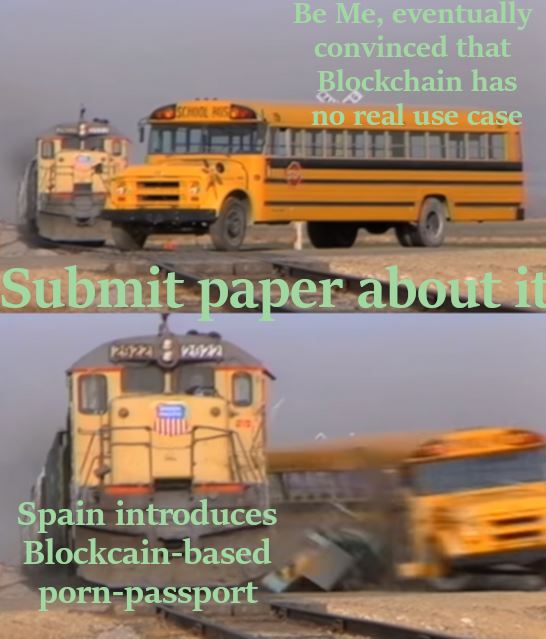
Spain did what
España creó un pasaporte blockchain para ver por alguna razón, porque supongo que los tiddies ponen nerviosas a algunas personas.
Source: Sé dónde está la biblioteca.
¿Qué?
This could be the right time to use an interrobang.
interrobang.
I know it’s a real thing, but I still think of a sexy FBI agent every time I see “interrobang”

I’ve never used one in my life, but I feel like it would have more impact in a language with writing rules such as Spanish’s.
And also the sexy agent thing.
⸘Que‽
If so, it was a lucky guess.
Por que: ¿Que?
me llamo t-bone la arana discoteca
Muy bien. Soy el langostino de los sueños.
Ahora esperemos que Porn Hub anuncie que no va a dar servicio en España como tantos estados Americanos que han hecho lo mismo.
Mi queso es su queso
Is it Blockchain based though?
It is a shitty porn passport, I’m Spanish, but I didn’t hear that it was Blockchain based.
Why? It needs a centrar register not an uncentralized one.
A blockchain does not mean decentralized. It means a public ledger where each new item validates the one(s) before it
Do they need blockchain for it though?
A distributed pseudonymous ledger for use by a centralised authority that will hold sensitive, personal information.
I think the paper was right.
https://www.politico.eu/article/spain-builds-porn-passport-to-stop-kids-watching-smut/ I guess this? Wild stuff.
deleted by creator
It is also mentioned that the rules could get superseded by EU law requiring identification as well. And with the US doing stupid stuff as well you might run out of VPN locations in the future
deleted by creator
I don’t think any country is going to make VPNs illegal anytime soon
They’ll just make them illegal for anyone other than a corporation
deleted by creator
Once verified, they’ll receive 30 generated “porn credits” with a one-month validity granting them access to adult content. Enthusiasts will be able to request extra credits.
…I’m sorry, what? Is the government keeping track of how much porn I use?
So they can raise a bronze statue to the biggest masturbator on town, of course.
deleted by creator
What about all the games where you can shoot people? Why is that okay for kids, but a little tit here and there will destroy their view of the world?
Didn’t these things get their starts by sucking on tits? So why hide them now?
deleted by creator
Let’s pair it with proper sex ed. Destigmatise sex work, break the taboos, but also teach people what is and isn’t okay or healthy, how arousal works for different sexes and why their dick isn’t God’s gift to womankind.
There is this famous spanish porn actor. Nacho vidal, who says that we would have a better world is kids would play around with plastic dildos instead of plastic guns.
I don’t know the playing with plastic dildos, but it is true how wild is the normalization of giving kids a replica of a human killing instrument to play with.
well you can’t have fun running around all summer squirting water at your friends from a dildo
at least, not without getting some truly vile looks from passersby
also it’s just intrinsically fun to try to shoot each other with harmless little darts that let you know you’ve been hit but not do anything else
Why would anyone chain their porn?
Cockchains are not for that. Not really for anything, but not for that too.deleted by creator
Not even sure why I’m bothering replying to this bot, but guess misinformation should not be left alone
- It’s not instant it takes a long time until enough confirmations have been done. It’s not even clear how many confirmations are enough.
- It’s only instant if you use the lightning network. Lightning network is literally a traditional bank transaction mechanism on top of bitcoin. If you are arguing for using lightning transactions, what is the point of bitcoin in the first place?
- fees are huge and will only increase in the future.
deleted by creator
I apologize, it looked like copy pasta.
You lock up BTC in a lightning channel, you can then send that BTC to anybody via lightning,
You can not send the BTC to just about anybody. Only to people with whom you have a channel open. If you want to send to anybody you need to hop through other channels using middlemen. That sounds very similar to the function of a bank.
deleted by creator
The last time I had to send 30 Euro to someone, I had to pay 5 Euro for gas fees. It used to be even worse. Your statements are bullshit, we all know what the usual use cases are (other than speculation)
it would be nice if the price of bitcoin was stable enough that when I sent $100 to somebody it wouldn’t be a gamble whether what they actually received was double or half that
deleted by creator
I don’t care about amount of BTC, I care about amount of dollars. It may also surprise you to learn that I don’t care about countries where the currency is so unstable that a currency that can double in value in the space of a few months has it beat.
If bitcoin is going to become usable as a currency, even in niche circles, it has two problems to solve: energy use (three quarters of a megawatt hour per transaction, according to Forbes!) and conversion stability. I don’t want keeping money in my wallet to be a high risk investment.
deleted by creator
Spanish government is implementing a sort of passport for people to be able to view porn.
They want that any porn website sited in Spain would ask any visitor for credentials to enter, thus assuring it’s over 18 yo.
We call it the “pajaporte”.
One of the things blockchain could do is become a digital proof of ownership, augmenting or replacing things like property deeds and car titles. We already agree that a written record of ownership of such things is legally binding (even if the writing is stored digitally), but transfer of that ownership to another person is still a very manual process. Imagine an NFT that represents ownership of your house, and when you want to sell your house, you transfer that NFT to someone else’s custody - adding their ownership information to it. It would record the entire chain of ownership, and specific details about the piece of property involved.
Without law enforcement, which is centralized anyway, your documented ownership is worthless. So if the state or a similar centralized real life organization, whiches existence people agree on, is needed to grant and enforce that ownership, blockchain is unnecessary. They can instead just store that shit in a database.
And who would the largest nodes on that blockchain be? The banks? Who could say and do whatever they conspired since they command >50% of the computing power and/or value?
The average person isn’t going to build a fucking blockchain node just to keep the deed to their house.
“Grandma, please you need to fill your basement with these ASICs or else script kiddies will steal your house”
That’s not how that works.
NFT is issued determining ownership to a property. Property sells, another NFT is issued, tied to the original one to maintain a chain of ownership. Issuance of a second NFT for a sale to a new owner would depend on authorization by the previous NFT holder. Lienholder information could also be stored, and linked to a mortgage NFT with payment history.
The “NF” part of that stands for “non-fungible.” As in, once created, cannot be changed.
What happens if a mistake was made and an NFT is erroneously issued (for example to the wrong person)?
What happens if the owner dies? How is the NFT transferred then?
Who checks that the original NFT was issued correctly?
What about properties that are split? What happens if the split isn’t represented in the NFT correctly (e.g. due to an error)?
The whole non-fungible part can be a problem, not a solution. It very, very rarely happens that ownership of a property is contested. It happens quite often that a mistake is made during a property transfer/sale that needs to be corrected. How do NFTs deal with this, and are they a solution to a non-issue?
See that’s the thing. Not being able to correct transaction errors is a feature of blockchain. I’d go as far as saying it’s the #1 feature of the majority of crypto that brings in all the scammers.
Personally I prefer my money being insured and controlled by the government.
What happens if a mistake was made and an NFT is erroneously issued (for example to the wrong person)?
That person has it now. They mjght volountarily be willing to send it back with another transactions or the courts could force them to do so (as in give fines, request keys, send to prison, or just have the government own and ooerate all the wallet keys and simulate transactions eith blockchain just as the technology used in a very janky way)
What happens if the owner dies? How is the NFT transferred then?
Similarily, either the government does all the transactions with ‘your’ keys for you, or you write down the keys in your will and have someone of trust (e.g. a lawyer) do the partitioning/transactions part in your stead.
Who checks that the original NFT was issued correctly?
The seller and buyer beforehand, mostly
What about properties that are split? What happens if the split isn’t represented in the NFT correctly (e.g. due to an error)?
Rebalance by having everone affected send their portions for redistribution to a trusted entity
As you’ve said yourself, NFTs seem wholly unsuited for keeping track of general ownership on a large scale. All the problems do have solutions, but they’re either complicated for the owners or it’s someone else controlling people’s keys, defeating the entire point.
It could. It may or may not. I agree decentralization is a good thing, but do governments agree as well? First of all, governments are very resistant to change if that doesn’t play into their interests (real or percieved like this privacy violation). Using a traditional database to keep track of ownership seems cheaper (since they already do it) but most of all simpler. I’m not too familiar with the way blockchain functions so I may be wrong, but say someone wants to sell a car. In the current state of most countries you just draw up a paper or fill out a form, maybe get it notarized and pay taxes. A database seems flexible enough that if your sale didn’t get logged and the buyer got pulled over and questioned, they could provide the contract and clear up any questions about ownership. Or say the ownership was stripped as part of a court order. If it was a database, then changing the records is simple, but with blockchain the court would either have to get you to transfer the ownership volountarily, force you to disclose your keys or have some mechnism of forcing a transaction from the requester account (which as I understand it seems what blockchain is here to stop abd a core part of the specification). Alternatively the government just uses blockchain instead of a database, managing all the keys, wallets and identities (as in they have everyone’s keys and do all the transactions) which is the same level of centralization as a database, but with extra steps.
Ownership was (and is) a social contract, and a flexible one at that. Things get gifted volountarily, sold, taken away lawfully and inherited in a single jurisdiction by the thousands daily, and not all of these are well documented. Blockchain seems very limited in what it can do flexibility-wise which makes it unsuitable for keeping track of ownership, and that’s not taking into account that either everyone would have to actively use the blockchain for their sales and be familiar with the technology (decentralized) or having all the wallet keys operated by the government (defeating any useful feature of the blockchain for citizens). Adding blockchain into the mix will just complicate the transfer process and centralize it (as in we either do all validation on the blockchain or none), and with the fact that all the transfer history is centralised in the blockchain (despite it being decentralised in storage, it’s still explicitly stored and accessible) it would serve as just another venue of privacy violation and opression.
Maybe blockchain could be useful for things like, say carbon credits, or similar government-issued ‘currency’, but I don’t see it applicable to validating general ownership on a large scale for the general population, ever. The ‘digital Euro’ proposal, also being blessed by the buzzword Blockchain seems very distopian to me as well. Here, with currency being used I can see how it would be applicable in the real world (instead of heavily unstandardised land deeds, sales contracts and other proofs of ownership you have strictly defined currency units), but this also seems like a gross privacy violation as the government (and maybe anyone) can see where you got your money and where you’re spending it down to the cent.
Git is a real-life use-case
Git is not a blockchain. Most importantly, it’s not distributed. There’s a singular git server that all git clients for that repository connect to and use as a source of truth.
https://git-scm.com/book/en/v2/Distributed-Git-Distributed-Workflows
In contrast with Centralized Version Control Systems (CVCSs), the distributed nature of Git allows you to be far more flexible in how developers collaborate on projects. In centralized systems, every developer is a node working more or less equally with a central hub. In Git, however, every developer is potentially both a node and a hub; that is, every developer can both contribute code to other repositories and maintain a public repository on which others can base their work and which they can contribute to.
Git was built specifically to avoid the necessity to have one authoritative server.
Counterpoint: it is a chain and there absolutely is not one server.
For each project there is one authoritative instance, one “server” that everyone pushes to. Otherwise you get chaos.
That’s not a git thing though. You can totally have multiple remotes and the remotes are just git repositories themselves. Git is 100% decentralized. There is technically nothing stopping you from having multiple remotes.
That may be how you use it, but that’s not baked into git. See my previous response. There’s a bunch of FUD in this thread for some reason.
People want simple answers, and “blockchain bad” seems to satisfy many
And nobody ever forked a project, and lived happily ever after, then end.
If you want to work with the original project, you have to push to the server that controls the original project.
No you don’t, you can just fork it, add a commit, and walk away, and everyone can decide which one they want to clone
Otherwise you get git. You’re describing svn.
Oh no Spain has an “innovative” idea to fuck the internet!
deleted by creator