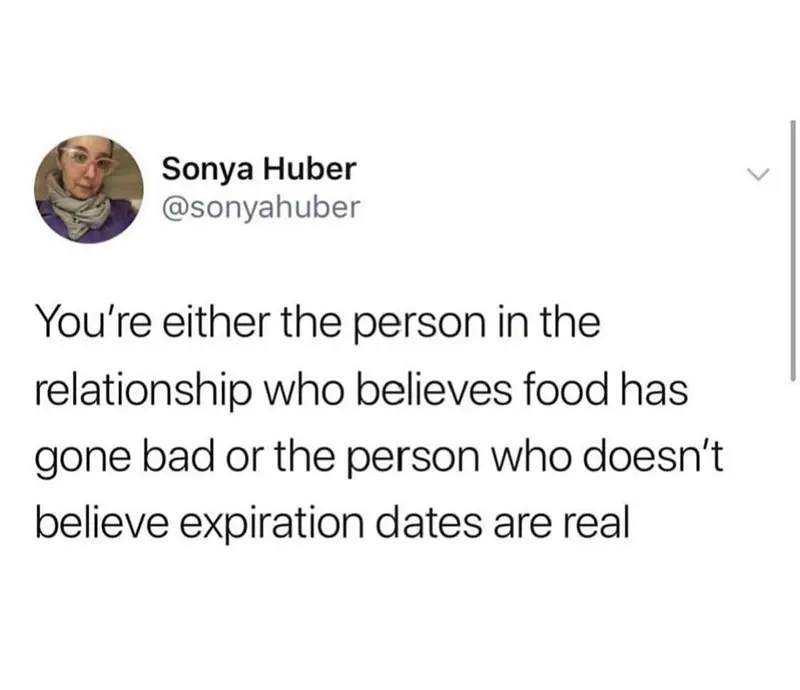
You must log in or # to comment.
Let me put it this way: They print expiration dates on SALT.
Now, it’s pretty convenient that stores here in Denmark sell products cheaper just before they “expire” because certain products actually get better with time like cheese.
Safe to say I’m the second type hehe…I don’t know if it’s correct, but for the first type I once read that it might be because of the packaging and/or the interaction between product and packaging that might affect the product. And even if it would still be “never expires”, the company doesn’t want to pay to verify.
It’s about liability. Companies don’t want their salt returned to them after x years, especially not with some lame excuse. So they just define an expiration date y that’s far off enough to not drive customers away, but still minimizes the risk of complaints.
If a (big) customer successfully complains within this time span, they’ll simply decrease it.
Expiration dates are literally made up, very infrequently will any actual testing be done to see the exact time it takes for a food to decay enough to be either unenjoyable, unpalatable or inedible.
They’re usually 1 week from mfgr for unpreserved foods, 2 weeks to a month for soft foods like American sandwich bread, 3 months to a year for dry goods (depending on what it is) and up to several years for canned goods.
My salt has an expiration date. Salt is a rock, it is millions of years old (not sea salt, mined salt). It does not expire.
I don’t know where you got your information, and I can’t speak for other food stuffs, but I used to work in a milk bottling facility. I did quality assurance. Part of my job was to take gallons of milk (many of them) and put them in refrigeration until two days after the expiration date, and then taste them. While most of them tasted pretty much fine, about 30% were sour, coagulated, or some other sign of type of spoiled.
Expiration dates are real, but they are an estimation of when the product will go bad. Use your own judgement. Smells/tastes bad/weird, or is oddly oily and stuff, probably don’t consume that. Seems completely fine but past the expiration date, you will probably be completely fine.
I don’t mean any offense but is hiring someone to drink expired milk the best way of testing it? Can’t they like measure bacteria or chemical composition or something?
Hahaha no, that’s a fair train of thought. Let me clarify firstly that we didn’t have to actually drink it. It was more of a sip and spit like wine tasting. As for the second part, those processes take materials and money that a human with a free 30 min doesn’t.
Yeah, most experiation dates are made up. Some are real, like milk usually. I’ll still drink milk after the date, but I always make sure to smell it if I’m approaching or past that date.
99% of foods you can smell or see if they’ve gone bad before you taste it. Always use your senses, not some date printed on it by a manufacturer that wants to sell more product. We’re literally evolved to identify food that’s gone bad.
My wife just threw out a ~12 hour old fried rice we doggy bagged last night that I was planning on lunching on because we “touched it with our spoons”. Sigh.
She does know that reheating leftovers is a thing, and that heat kills bacteria, right?
Oh they’re real. They’re just arbitrary most of the time.
Expiration dates are useful, but they are not usually a hard end point to a food’s safety or edibility.
In Japan they have two types of dates, which map to “Use by” and “Best before”, but they don’t use them interchangeably or some vague middle-of-the-road term like “expiry date”. One is operative, the other is a recommendation.
消費期限 (shouhi-kigen) literally means “consumption time limit” and 賞味期限 (shoumi-kigen) literally means “guarantee of taste time limit”.
deleted by creator
Expiration date believers are my sworn enemies.
When I was 14, I hated cheerios and had a whole pack bit noone in my family liked em.
Noticed it expired the same date as me and my brothers birthday and we excitedly waited and threw it out on our birthday.
Still regret it to this day.
There is no “expired”, only “improperly fermented”. Sure, it could be very bad, but then you should’ve paid attention to it in advance, respect the nutrient and all living things who brought it about.
Could you explain your suggestion that there’s a correlation between one’s subjective awareness of a food item’s nutritional content and it’s objective fitness for human consumption over time? These things seem entirely unrelated to me.
There is nothing subjective here, it’s knowledge of biochemistry and manufacturers use of good practices. Of cousre, this is impossible on large scale production, yet you could be sure that your local milk providers milk will just become something else upon curdling, and your local butchery vacuum sealed bags are as clean from pathogens as their line and are good far beyond expiration date, but will change. And that things were stored correctly and are not blooming with thermophiles inside. I do not mean nutritional content, I only address industrial labeling and its purpose. And things that could not possibly be regulated, and have to rely on community (in many forms, from “lets love each other” to “I will break your face if you burn me, pal”). Eating expired stuff is an act of trust, whether it is trust to chance and supernatural, or trust of community that builds cultural value, is a whole different question.
Then you can always inoculate food yourself before expiration, but then it counts as cooking I guess.
What if neither of you believe in expiration dates but one of you think it turned and the other doesn’t?
These do not sound like mutually exclusive perspectives. Why not both?
I was germophobic my entire life up until like a year or two ago where I kinda got over it and stopped giving a shit, but I’m still incredibly paranoid about food expiration, even when the best before day hasn’t been reached as is 1-2 days away.