

february 2026 mo tu we th fr sa su 1 2 3 4 5 6 7 8 9 10 11 12 13 14 15 16 17 18 19 20 21 22 23 24 25 26 27 28I wish this is how we arranged it. Makes so much more sense
Alas, my brain is too used to wed in the middle
feb 2027
nice
I only go by the Linux “cal” command.
right! like, why complicate things?
But my cal starts on Sunday. What are your locale settings?
that means (if your locale is set according to your position), you are probably somewhere in the blue area on this, while I’m in the orange.
https://commons.wikimedia.org/wiki/File:First_Day_of_Week_World_Map.svg
“cal” command.
TIL about
cal. It’s a standard util-linux command! And it follow my locale automatically :0
Motu weth, fr’sa su
Cthulhu awakens
ISO-8601 strikes again. Sunday week start master race rejoice
Monday is the start of the week and I will die on this hill
https://en.wikipedia.org/wiki/ISO_8601
[D] is the weekday number, from 1 through 7, beginning with Monday and ending with Sunday.
https://en.wikipedia.org/wiki/ISO_8601
[D] is the weekday number, from 1 through 7, beginning with Monday and ending with Sunday.
I always knew starting the week on Sunday was messed up. Thankfully there’s an ISO to back me up
It also say YYYY-mm-dd should be date and HH:MM:SS should be time and YYYY-mm-ddTHH:MM:SS should be datetime. But it also allow extremely cursed datetime, many prefer rfc3339
I use that date format for saving work docs anyway. And use dd/mm/yyyy for anything else.
Although thinking about it, maybe I should just adopt the international standard for everything
It would be perfect if it wasn’t for that fuck-ugly ‘T’ separator between date and time that also makes it harder to read.

Who the hell starts the week with Sunday?
Brazil!
Monday is called “Segunda” wich means “second” and every weekday follows this. So the Nth day of the week is called Nth except weekends
Yeah well, it’s called october but I still think of it as the tenth month 😬
I always think of segunda-feira as the first day of the week, despite the name; though it appears that calendars here start on Sunday (something I’ve never noticed).
While it is the first day of the work week, it makes more sense to think of it as the second day in Portuguese so the naming stays consistent.
A lot of us, apparently
heard it’s the British
I don’t get it…
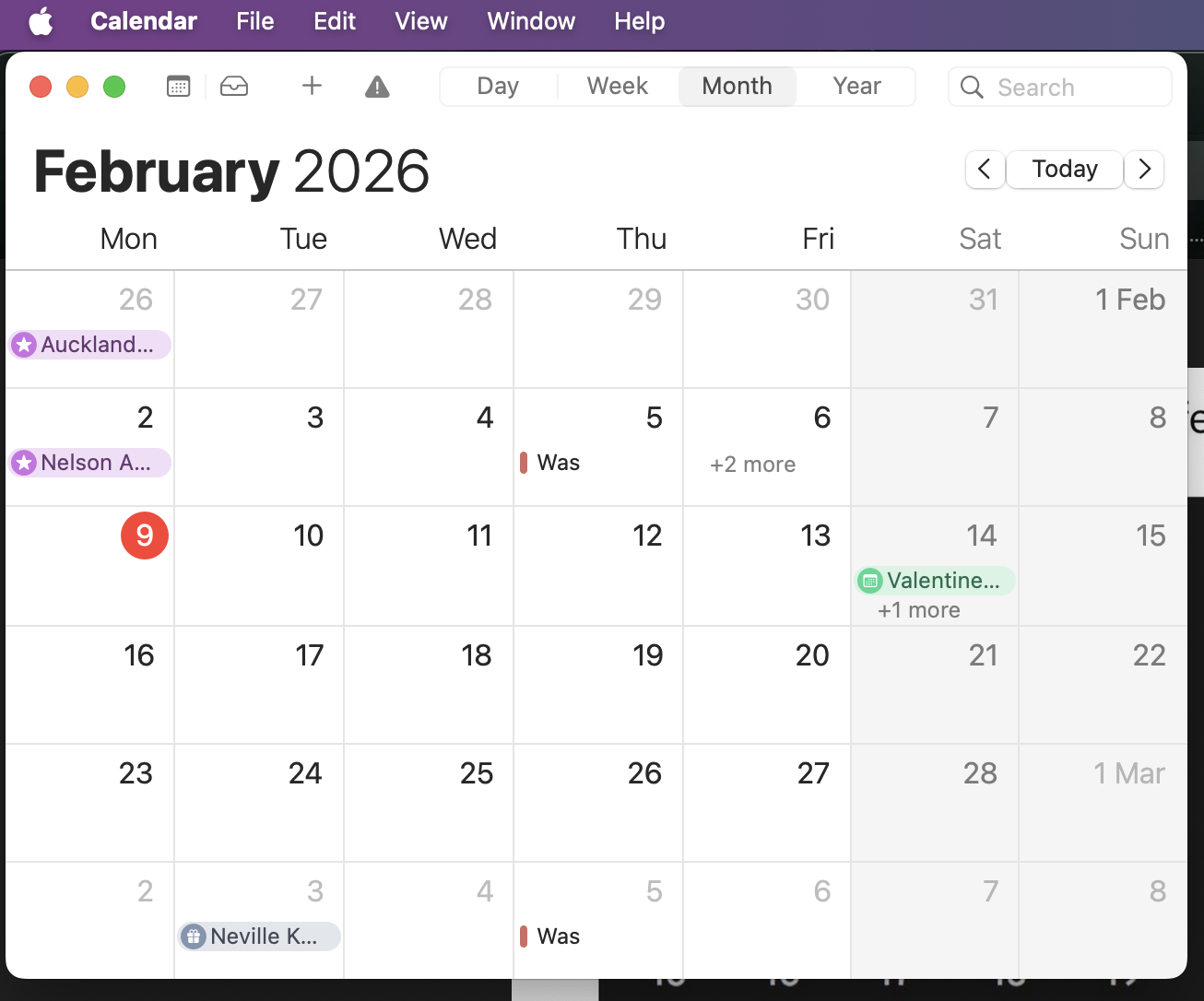
This could be every month if we adopted a 13 month calendar of 4, 7 day weeks. Works out very cleanly with only 1 extra day per year.
Combined with Holocene calendar and decimal time… hnrggh… one can dream! I actually designed a spreadsheet for exactly this and it works perfectly. Only issue is that it doesn’t auto-update, you need to edit an empty cell of the spreadsheet (doesn’t even need to be saved), for it to update to the current time.
Would be nice to have an installation that lets you use that calendar and time format…
I actually like the 12 or 60 based time! Couldn’t we change to base 12 for everything instead? 🥺
Yeah, I’m a fan of using minutes instead of percentages. For example instead of 33.3̅% you can write :20 or 20’ - like in the old fixed-point arithmetic days!
Time already is that.
The true ideal.
While we’re changing the calendar, can we rename September through December so they’re not off by two?
Septem, Octo, Novem and Decem are the Latin words for 7, 8, 9 and 10 respectively, but they’re actually the 9th, 10th, 11th and 12th months of the year. This is because the Roman calendar was originally only 10 months, but Julius Caesar inserted two new months in the middle, without renaming the last four.
Maybe the oldest tech debt in existence - the calendar was changed in 45 BC.
In Japanese months are named based on the number of the month, literally “first month” to “12th month”, which is the most sensible way to do it
Why not just call February 2026 “month 2 of 2026” and call the 9th of February 2026 “the 9th of month 2 of 2026”
That’s essentially how the Roman calendar was named for six out of the 10 months:
- Martius: (Mars)
- Aprilis: (from aperire, “to open”)
- Maius: (Maia, goddess)
- Junius: (Juno, goddess)
- Quintilis: (Fifth)
- Sextilis: (Sixth)
- September: (Seventh)
- October: (Eighth)
- November: (Ninth)
- December: (Tenth)
People are superstitious and would never allow a 13th month
Worse than that, in order to preserve the date/day-of-week correlation, the extra 1-2 days (you still need leap years) would not have to be part of any week.
So that’s instant opposition from all the Abrahamic religions.
Agreed. It’s so simple and beautiful.
- The once a year extra-day is an international Eat The Rich holiday. Probably tied to the winter solstice.
- And every fourth year we all get a bonus-extra Leap Purge holiday.
The Gregorian calendar has nothing on this!
I like this better than the French revolutionary calendar’s ten-day weeks. Maybe if they had included more than two weekend days people wouldn’t have hated it so much
My FiL gifted me an art calendar from 1998. I was confused at first, then he said the calendar days of 1998 are the same days for 2026. So, that’s a thing we all know now!
There exist only 14 different calendars.
Jan 1= monday, Jan 1 = tuesday, …, Jan 1= sunday, and again the same 7 combinations for leap years.
There is a difference for hollidays like easter that are based on the moon cycle, but just from the days of the week its only 14.
Neat!
1 in 7 chance [if you sample from infinite years]
the first day of the month moves forward one weekday each year except mar-dec on a leap year which moves forward two weekdays
That can’t be correct, can it?
They would have a rotating 7 year schedule, but it’s messed up by leap years. You have the seven calendars you’re thinking of and 1-2 leap year calendars mixed into those 7 years. It would have to be somewhere between 1 in 8 and 1 in 9, wouldn’t it?
I think it’s more like 303/2800 chance.
There are 97 leap days every 400 years, then the calendar repeats. So you have 303/400 chance of not having a leap year, and in those years, you get a 1/7 chance of having this calendar. Thus 303/2800.
This is counterintuitive to me, because 303/2800 is .108, which is between 1/9 and 1/10. But 97 out of 400 is less than 1 out of 4, so it shouldn’t be able to interfere more than twice in a 7 year cycle, on average. But your math looks correct. I must be missing something.
No, since there’s only 7 different possibilities, then over a sufficiently large sample, the probabilities would all still balance out to 1 in 7.
This should be always. We could easily have 13 months with an even 28 days, or four weeks, every year. But, you’re going to say, “What about that last day?” That’s new year’s day, it’s once a year, not ever a regular day of the week, and every leap year we get 2 of them and make a weekend of it. Those remainder calendar days don’t need to be a particular day of the week, we can just make them holidays and stop worrying about it. Or we do keep them as regular days of the week and the calendar shifts by a day or two every year. I don’t really care. I just want the months and weeks to be at least a little less chaotic. And if there is going to be a chaotic little remainder weekend every year, it might as well be a party.
What I’m going to say is: technology. The calendar will never change because of technology. This would be the most expensive and extensive change in history. Every computer system, program, device everything.
And you have to either retroactively change past dates, or support 2 systems at the same time. It’s almost insurmountable at this point.
I’ve lived through attempts to switch to metric and Y2K. Tech problems are easy compared to changing direction against societal interia.
No it’s not, this means there’s two Friday the thirteenths.
I mean that happens twice in the same year sometimes anyway (2024).
But when February does it, it does mean two consecutive ones.
Disordians want a word
We could have 12 perfect months s year if we switched to a 13 month calendar.
chat is this real?
My daughter ripped off part of the February sheet on the calendar. Because it lines up so perfectly, March just auto fills in the ripped bits.
What ?