
Thanks! It’s a combination I think. Some lines are just the fingers leading and the sense of rhythm telling me to start a run and then stop when I hit a chord tone on a strong beat. Some are deliberate arpeggios that are meant to extend the chords underneath (I’m bad at this imo, but I think it’s pretty important to practice). Some lines are just the mind following the melody where it leads, only subtly aware of the chord tones (practicing singing the melody you’re playing is wonderful for this). And some are just licks :)

PhD candidate in ethnomusicology at UT Austin. Currently writing about sound, experimental music, and urban change in Austin, Texas.
On the microblogging side of fedi: https://assemblag.es/@halfflat
- 2 Posts
- 21 Comments
Joined 3 years ago
Cake day: June 5th, 2023
You are not logged in. If you use a Fediverse account that is able to follow users, you can follow this user.

You might also try @ing the group directly from pixelfed in the post, eg
@creative@beehaw.org. Idk if that will work but you can try!
Weird, I’ve had pixelfed stuff automatically embed correctly before!
 1·3 years ago
These are amazing renders. I’m so bad at go but I made an effort to play more a few weeks ago and it’s a ton of fun.
 3·3 years ago
No prob! I’d actually recommend making an account on one of the kbin instances if you’re curious at all about it. It works a little differently and has some unique design goals which gives you a bit of a preview of how the fediverse might move forward into the future and beyond the web 2.0 that we all know. Interesting things are ahead, it seems :).
Kbin.social is (at least since I last checked like 30 minutes ago) federating, they removed the cloudflare ddos protection that was making federation impossible a few days ago. If you take a look at the kbin’s all page you’ll see plenty of material federating from lemmy.world and us over here on beehaw. You should be able to just search for kbin magazines with the regular Lemmy search, but I’ve found that to be inconsistent.
Haha, I just had this problem, and weirdly the solution was to search for the owner of the kbin magazine, navigate to their post history and find the magazine/community that way. A bit clunky 😅.
Truly, there are few things better in this world than seafood + noodles + sauce

 2·3 years ago
Fascinating. The origins of the method are a real rabbit hole too, I kinda miss the era where stuff like this would crop up on forums.
For Spanish I‘ve been on a hour-a-day schedule combining reading a novel on lingq, duolingo (which is a handy review tool if nothing else), and verb form flash cards. I do plenty of extra stuff outside of that, watching shows and podcasts in Spanish, but the 10 hour a day timeframe advocated by the original L-R sources is definitely intense.
Anyway, thanks for the write up! Some great sources here for sure.
 1·3 years ago
Thanks! Yeah, it’s a really provocative element of the tuning. I’m still wrapping my head around phrasing with the leaps that are right under the fingers.
I had never heard of the L-R method before, it’s kind of astonishing that it has worked for folks. I suppose LingQ/LWT combines some of these approaches together — it’s hard to imagine doing 10 hours of LingQ reading though.
Tremendous.
Hey thanks! As for what it enables, it definitely allows for wider voicings to be under your fingers, and the tuning is more consistent until the highest string, so thinking across string groups is easier. A lot of your familiar patterns will sound interestingly shifted, and it makes you think about phrasing pretty differently.
What you lose is some of the familiar, honky, close-together sounds of the guitar we’ve all grown up with. Playing a major or minor second (as opposed to a ninth) is pretty brutal.
All in all, I’ve found it a useful way to expand musically, but it’s not a perfect experience, which is kinda what Fripp was going for when he developed it. There are absolutely some gorgeous chord voicings that I don’t ever wanna lose (kinda like the first time you ever slid an open C shape up a wholestep).
Thanks dude!
Hey thanks! I appreciate it!
Unfortunately I think it’d be complicated as far as moderation goes, because posts would have to be moderated across instances by different mods.
Haha, good to know! Just wanted to be sure I wan’t cluttering a space unintentionally! 🎸
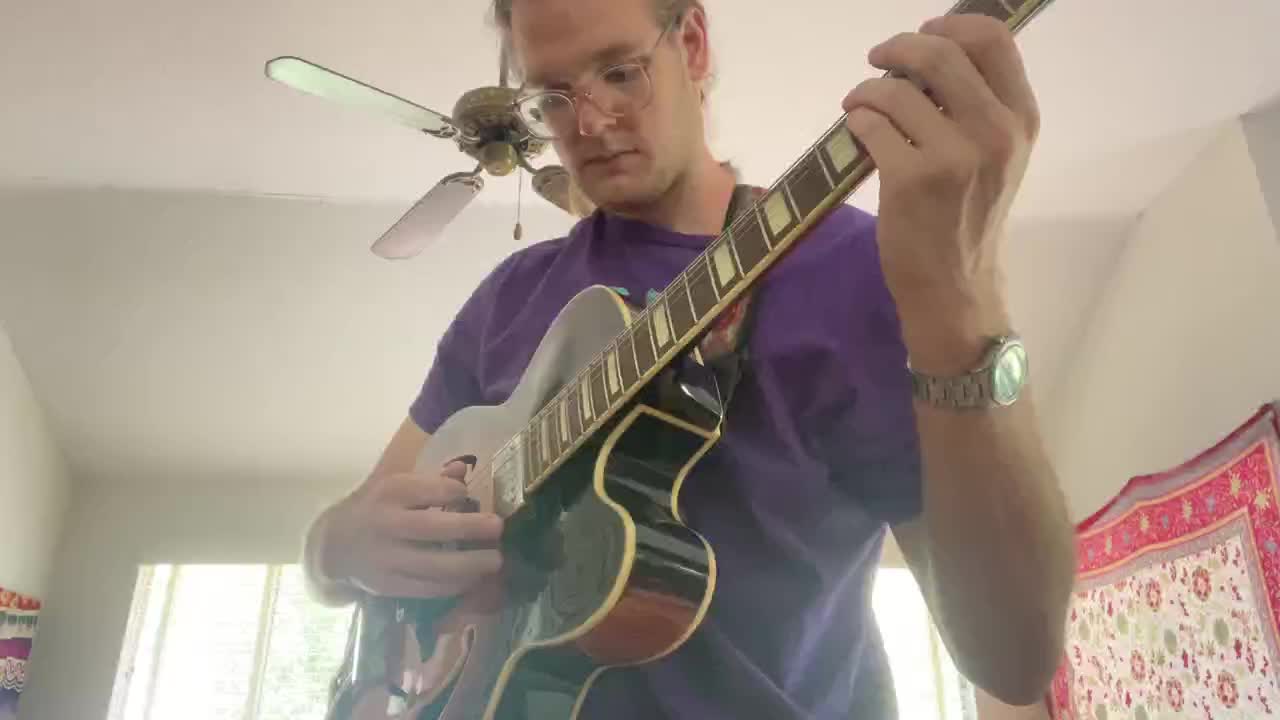
Haha, it’s interesting, I started grad school with a different project (more about noise, improvisation, and politics) and just kind of fell into it because of the way that some of my writing in various classes progressed! That’s how grad school in the humanities goes often, your classes begin to mold your ideas differently.
I’m an ethnomusicologist! The diss is focused on experimental music and sonic communities in Austin and their relation to the city’s transformation over the years.
Thanks, I appreciate it 😎